Welcome to WordPress. This is your first post. Edit or delete it, then start writing!
Category: Uncategorized
-
The Circular Home: What Zero-Waste Living Could Actually Look Like

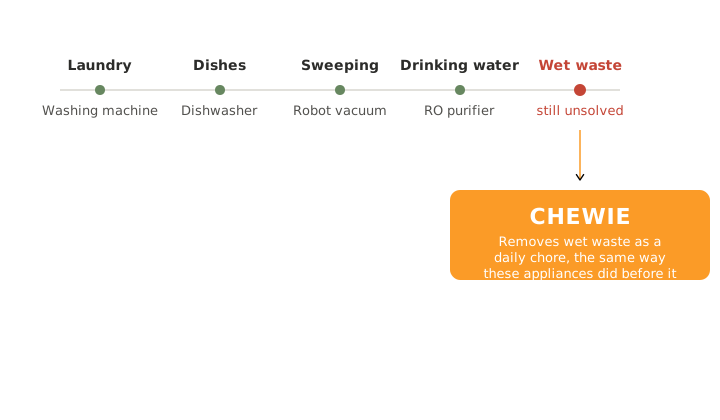
The real history of the modern home is not a story of architecture or aesthetics but of progressive automation of household chores. Each generation inherited a home that did more work with less human effort than the one before it. Laundry moved from the river to a small tub to a plug-in appliance. Food moved from daily market trips to a cold-storage unit that lasted a week. Cleaning moved from brooms to vacuums to robomops that navigate rooms on their own.
The pattern is consistent: identify an inconvenient task, engineer a system that removes the daily effort, and the household adopts it without much persuasion. Nobody debated whether to buy a refrigerator on ecological grounds. They bought it because carrying ice was tedious.
Circularity Is Not a New Idea
Before the linear economy (extract, consume, and discard model) most households were already circular. Many households in earlier generations were already practicing sustainability, even if they never used that word.
Food scraps fed animals or returned to the soil. Containers were repaired before they were replaced. Clothes were repurposed into rags, then into stuffing, then into nothing. Water from cooking vegetables was used to water plants. The Japanese concept of “mottainai”, roughly translated as “what a waste”, captured a whole philosophy of regret around discarding anything that still held value. In Indian households, the same instinct lived in different language: the steel dabba that lasted four decades, the pressure cooker bought in 1987 that still functions, the practice of repurposing rather than replacing. The circular home, in that sense, is not an invention but is a rediscovery.
What changed was urbanisation. Apartment living removed backyard composting. Nuclear households replaced extended families who distributed resources and labour across generations. Convenience packaging grew because the infrastructure for packaging waste did not. Municipal systems were designed to absorb the consequences of linear consumption, and for a while they managed. But now they are unable to withstand the same.
The interesting question is not how to persuade modern households to return to the circular instincts of their grandparents. The question is: what would those instincts look like if they were rebuilt into modern infrastructure, at the same level of convenience people currently expect from refrigerators, inverters, and hot-water geysers?
Why Does Sustainability “fail”?
The Energy Loop
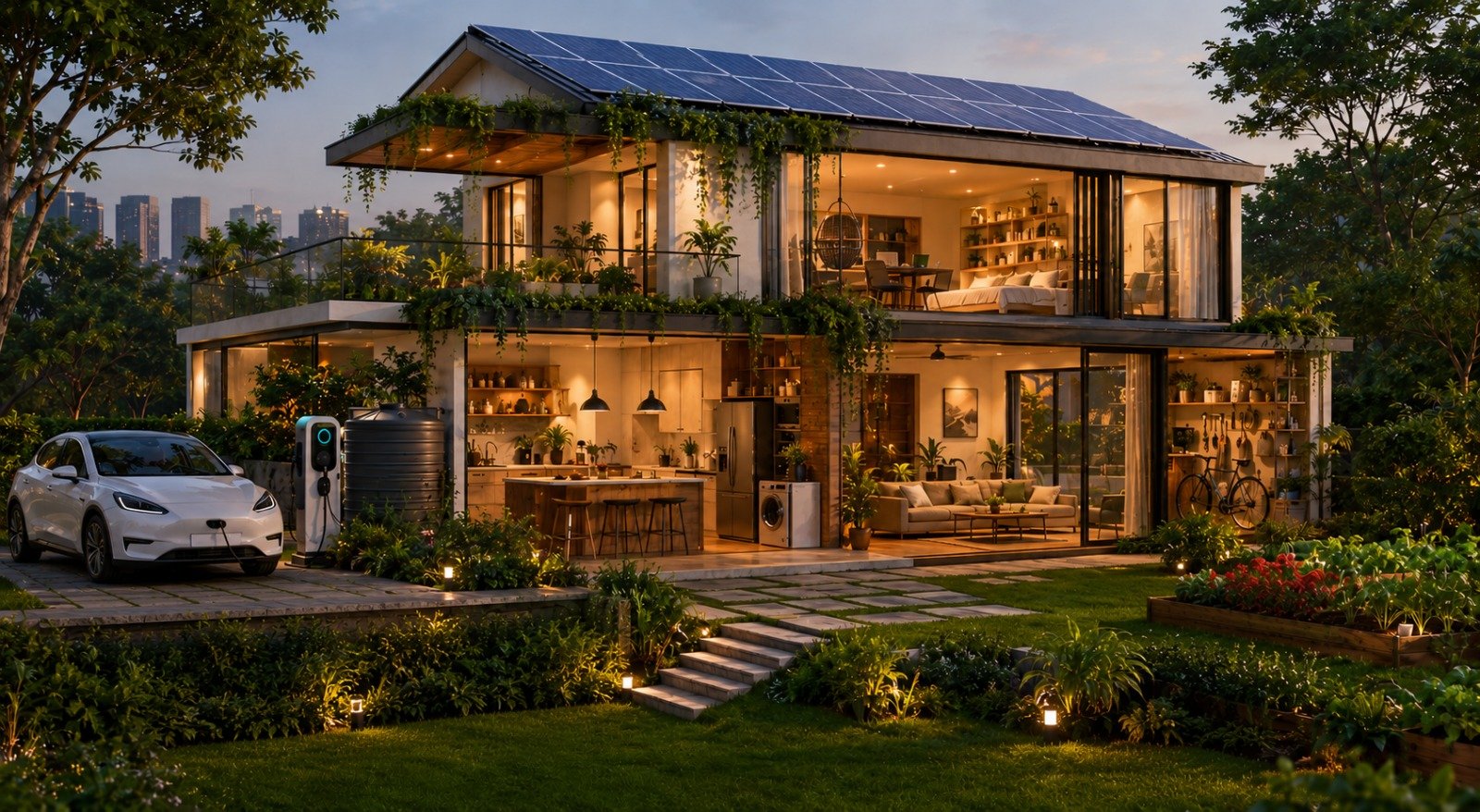
Energy enters the home, powers appliances, and is either used efficiently or wasted. In the circular home, rooftop solar offsets grid dependence. Battery backup maintains continuity without diesel. Smart metering identifies consumption patterns. Load management prioritises essential systems. The goal is not complete self-sufficiency. It is reduced dependence and reduced waste. In Indian cities where grid power remains unreliable, energy circularity is not idealism. It is a practical response to a structural unreliability most urban households have already internalised.
The Mobility Loop
EV adoption among premium urban households is accelerating. The transition from petrol to electric is partly economic, partly environmental, and partly about status. Over a ten-year ownership horizon, the total cost differential increasingly favours electric. More meaningfully, the home and the vehicle become integrated systems: an EV charging in the basement overnight draws power from a solar system on the roof, closing a loop that a petrol car can never participate in.
The Water Loop
In Bengaluru, water circularity is not an aspirational concept. It is a requirement. The city’s dependence on tanker water has grown as groundwater has significantly declined. Apartment complexes that built sewage treatment plants years ago are now discovering that treated water can irrigate landscaping, flush toilets, and supplement construction demand, dramatically reducing what they need to buy. Rainwater harvesting mandates exist on paper across most Indian urban jurisdictions. The homes that implement them seriously are now the most water-secure. Greywater reuse, efficient fixtures, and leak detection complete the loop.
The Waste Loop
Source segregation is necessary but not sufficient. Dry waste must remain dry and uncontaminated to be recyclable. Wet waste is the primary contaminant, because when it mixes with dry waste, it renders materials unrecyclable. Sanitary waste, e-waste, hazardous materials, and packaging each require separate channels. Communities that manage this well are beginning to qualify for significant exemptions under India’s evolving solid waste management framework. The incentive structure is increasingly aligned with the behaviour required.
The Food-to-Soil Loop
This is the loop that most homes currently abandon entirely. Organic waste contains significant nutrient value such as nitrogen, phosphorus, potassium, and microbial diversity. When deposited in a landfill, it decomposes anaerobically, generating methane and leachate. When processed correctly, it returns those nutrients to soil in a form that supports plant health.
The kitchen is where the circular home either succeeds or fails. It is also where the most visible gap in domestic automation currently exists.
A Day Inside the Future Circular Home
A family lives in a high-rise apartment in a gated community. The building is ten years old, well-managed, and served by an STP that routes treated water to the landscaping and basement car wash. Solar panels on the terrace offset roughly forty percent of common-area electricity consumption. The basement has twelve EV charging points.
The husband leaves at seven-thirty. His car charged overnight. He does not think about it. The wife works from home three days a week and leaves on two. The children are in school by eight.
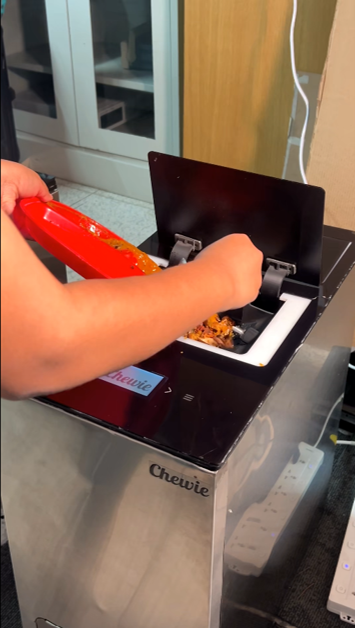
In the kitchen, the morning’s vegetable peels from breakfast preparation go directly into Chewie. There is no separate bin. The dry waste such as cardboard, clean plastics, glass, etc. accumulates in a separate bag and goes out on collection day. The society has a dry-waste partnership with a recycler. The material is not contaminated because it never met the wet waste stream.
The apartment’s smart meter monitors consumption. The air purifier has been running since six, triggered by the AQI reading from the nearest monitoring station. The water softener regenerated at two in the morning when the building’s demand was lowest.
Nobody in the household made a decision about any of this. No habit was heroically maintained. No discipline was required as all systems in place simply ran.
Bengaluru as Preview
Bengaluru is often cited as India’s “Silicon Valley”. It may also, inadvertently, be becoming its most instructive laboratory for circular-home thinking, not because its citizens are unusually environmentally conscious, but because its resource infrastructure has degraded far enough that households have begun building resilience themselves.
It is the same logic described in the conversation about power backup. When the grid becomes unreliable, people buy inverters. When municipal water supply becomes unreliable, people invest in borewells, and then in treatment systems when the borewells become brackish, and then in tankers, and then in rainwater harvesting when the tanker economics become punishing. When garbage collection becomes inconsistent, communities begin exploring on-site processing.
This is not environmental consciousness. It is self-interest expressed through infrastructure investment. And it produces outcomes that are better for the city than whatever the alternative was.
Bengaluru’s apartment communities are now among the most sophisticated informal waste managers in India. RWAs in upscale areas in Whitefield and Indiranagar have built OWC systems, negotiated dry-waste contracts, and reduced their municipal dependence significantly. The motivation was rarely climate concern. It was usually a combination of regulatory pressure, rising costs, and the simple desire to not live next to a rotting pile of waste. The city, in that sense, is a preview. Not of what India will choose. But what India will be forced toward, and then eventually prefer.
The New Definition of Premium
For most of the twentieth century, premium residential living was a signal of accumulation. Larger floor plates, more expensive materials, higher staff ratios, and grander lobbies. The luxury home was understood primarily in terms of what it contained.
But that is shifting. The shift is most visible in how the world’s most sophisticated residential markets are evolving.
In Singapore, luxury housing in newer developments is increasingly judged on energy independence, water management, and indoor air quality metrics alongside the traditional categories of finishes and location. In Scandinavian residential design, the premium signals are almost the inverse of the old model: absence of visible infrastructure, silence, reliability, and a home that imposes minimal operational demands on its residents. Net-zero luxury developments in California are now marketing their energy performance as a primary selling feature, not an afterthought. The transition can be described simply: old luxury was about more. New luxury is about better operations.
A premium home that produces no kitchen odour is more pleasant to inhabit than one that does. A home with water security is more resilient than one without it. A home that requires fewer trips to the municipality, fewer conversations with the RWA, fewer daily negotiations with broken downstream systems is a more comfortable home. These are not environmental arguments. They are quality-of-life arguments. The environmental consequence is real, but it is a byproduct of the primary benefit, which is simply living better.
What the Evidence Says About Scale
Behavioural economists have spent the better part of three decades documenting a consistent phenomenon: people rarely fail to act sustainably because they disagree with the goal. They fail because the behaviour is annoying.
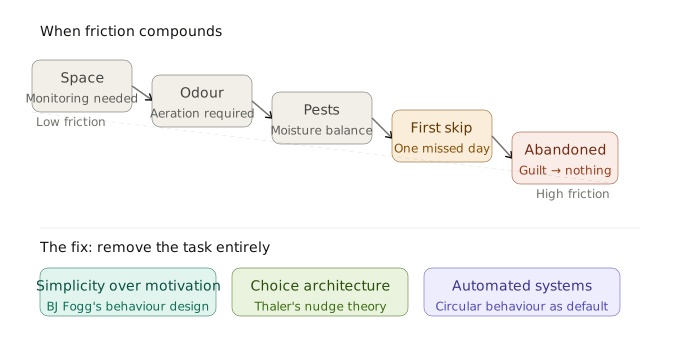
Richard Thaler’s work on nudge theory established that small changes in how choices are presented have a larger impact on behaviour than information, incentives, or appeals to values. And, BJ Fogg’s behaviour design research concluded that the most reliable predictor of whether a person sustains a new habit is not motivation but simplicity.
This is how human cognition works under the conditions of modern urban life. A household managing a ten-hour workday, a school run, elderly parents, weekend commitments, and a rotating domestic help schedule does not have a surplus of time to be sustainable.
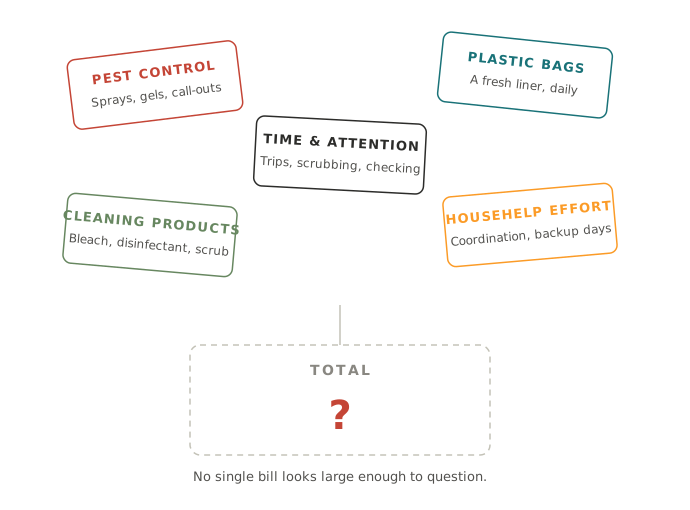
Composting is a perfect example. The evidence for its benefit is unambiguous. It diverts organic waste from landfills, reduces methane emissions, returns nutrients to soil. Awareness of those benefits is not the constraint. The constraint is that composting, done traditionally, requires space, monitoring, moisture management, aeration, and a tolerance for occasional pest and odour problems. Every one of those requirements is a friction cost. And friction compounds. The first skipped day becomes a skipped week becomes an abandoned bin becomes guilt becomes nothing.
Sustainability will not scale in India by asking households to become better waste managers. It will scale when systems remove waste management from the list of things households need to manage at all.
What Does an Ideal Circular Home Look Like?
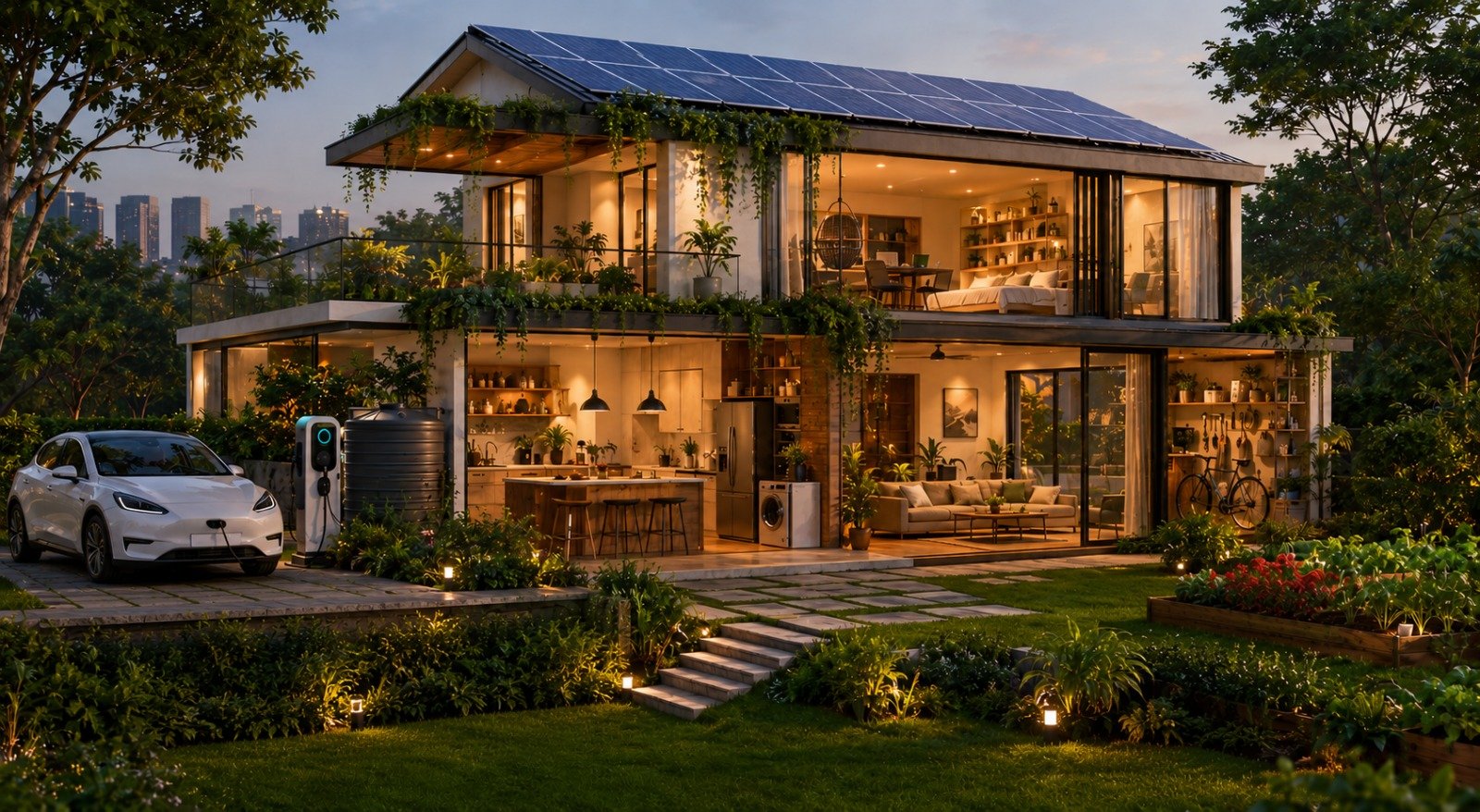
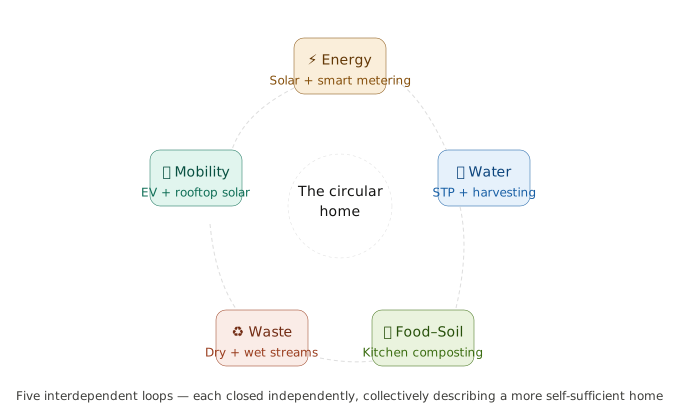
The circular home is neither a hut nor a minimalist aesthetic exercise. It is a smarter, cleaner, more deliberately designed version of the modern urban home, one that treats resources as inputs to be used efficiently. It can be useful to think of the circular home through five distinct loops, each corresponding to a category of resource flow.

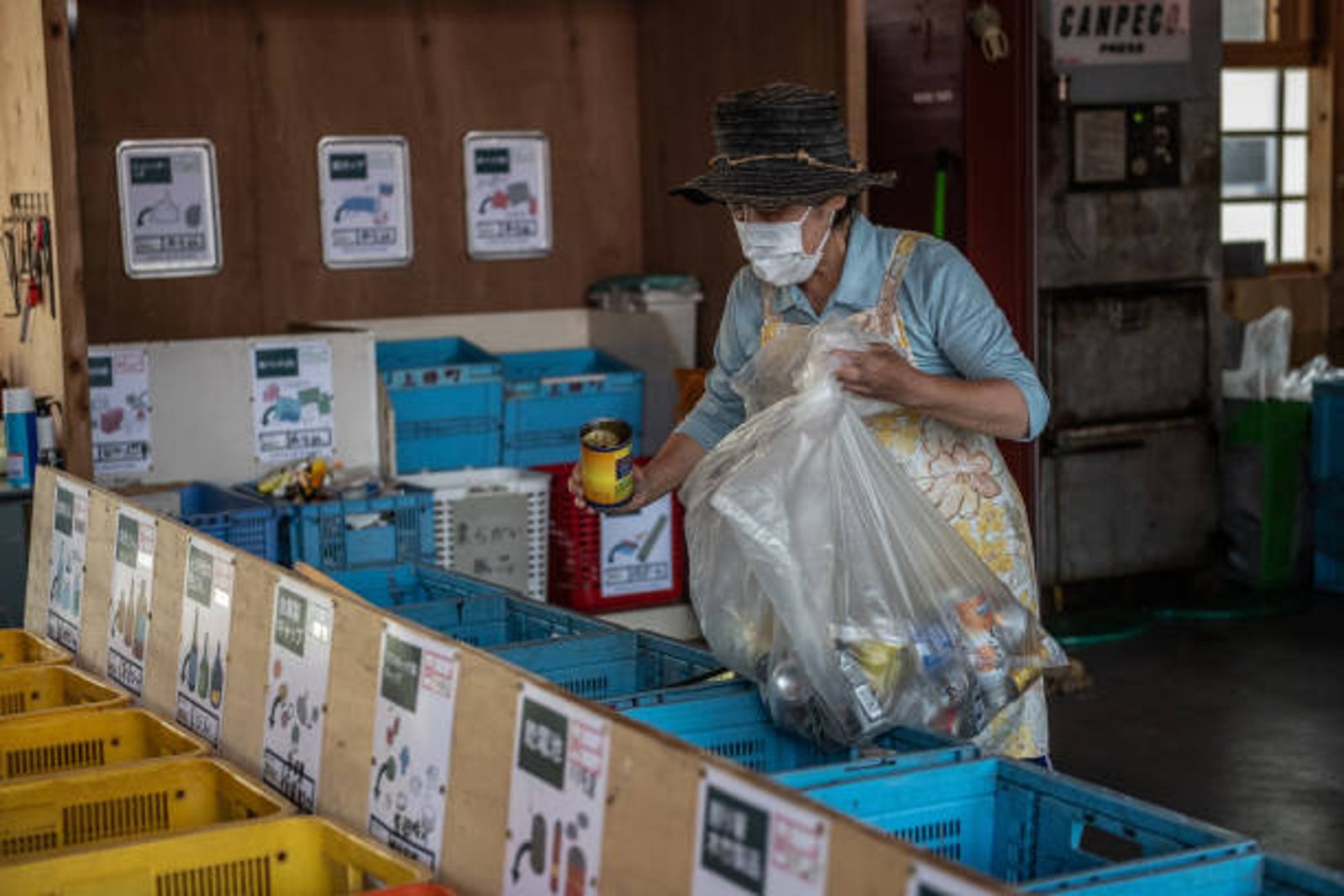
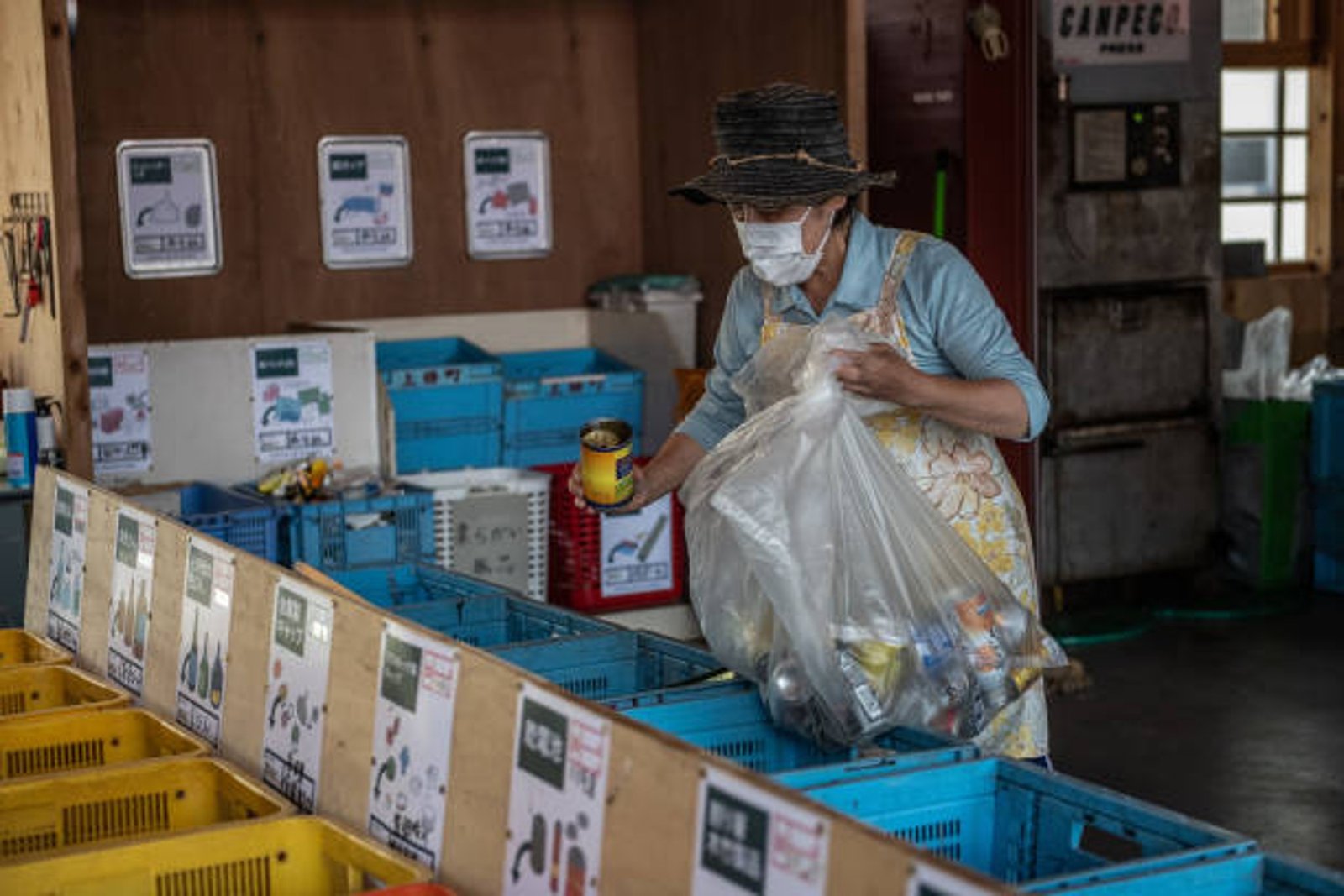
The most frequently cited example in circular-living discussions is Kamikatsu, a town of roughly fourteen hundred people in Tokushima Prefecture, Japan, which famously operates a forty-five-category waste sorting system and diverts close to eighty percent of its waste from landfills. Kamikatsu is instructive, but the lessons that travel are not the ones usually drawn from it.
The forty-five categories are not the point. The point is that Kamikatsu built physical infrastructure to facilitate the same. A centrally located resource centre where residents deposit their waste and are supported by people who can help with classification. That made the behaviour far less burdensome than the number of categories implies. The lesson is not “sort more.” It is “design infrastructure that makes sorting easy enough to sustain.”
South Korea’s food waste policy reinforces this. Mandatory separation and volume-based charging, introduced incrementally from 2005 onward, achieved near-universal compliance within a decade, not because Korean households are unusually disciplined, but because the combination of price signals and improved collection infrastructure made compliance the path of least resistance. When circular behaviour is the easier option, circular behaviour scales.
The pattern is the same in every geography where circular systems have actually scaled. Systems work. Appeals to conscience do not. Infrastructure creates behaviour more reliably than awareness campaigns.
The Whole Truth
Complete zero-waste living is not currently possible for most urban Indian households, and it would be dishonest to suggest otherwise.
Modern urban life generates packaging waste from supply chains, e-waste from device replacement cycles, textile waste from changing consumption patterns, construction waste from maintenance and renovation, medical waste, and supply-chain emissions that households have no direct mechanism to address. Not all materials can be meaningfully recycled within local infrastructure. Not all consumption can be made circular through household-level choices.
The goal, honestly stated, is not absolute zero. It is a home that sends dramatically less waste outside, that treats the kitchen, the water system, and the energy infrastructure as loops rather than pipelines, and that reduces dependence on downstream systems that are already overloaded.
That goal is already achievable. It does not require heroic behaviour. It does not require the abandonment of comfort. It requires applying to waste the same logic that Indian urban households have already applied to power, water, and air: if the system outside is unreliable or inadequate, build the solution inside.
Tomorrow is Being Built Today
The circular Indian home is not a fantasy reserved for some future decade. It is a stack of technologies and habits that are already available, already being adopted by premium urban households, and already producing the outcomes the concept promises.
Solar is on more rooftops than it was five years ago. EVs are in more basements. STPs are treating more water. Dry-waste partnerships are diverting more material from landfills.
Each loop, when closed independently, produces a measurable improvement in how the home operates. Collectively, they describe a home that is quieter, cleaner, more resilient, more self-sufficient, and substantially less dependent on the external systems that have historically absorbed the cost of how we consume.
That is not a description of a sacrifice. It is a description of a better-run home.
The washing machine did not spread because households understood the thermodynamics of detergent chemistry. It spread because it was demonstrably better than the alternative. The refrigerator did not spread because households had developed a considered position on food safety infrastructure. It spread because the convenience was obvious and the quality-of-life improvement was immediate.
The circular home will spread for the same reasons. Not because its residents have arrived at a particular view of environmental responsibility. But because living this way is simply better. Less waste, less smell, less friction, less dependence on systems that no longer work well enough to be dependable.
Zero waste may be the destination but effortless circular living is the route.
-
Indian Manufacturing Ecosystem: The Grime of the Ancient Manufacturer

The Vendor Ecosystem: What It Actually Is
When people discuss India’s manufacturing challenge, they often reach for broad explanations: infrastructure, policy, capital, logistics. All of them matter. But for a product company, the pain is experienced at a more immediate level: vendors.
A true manufacturing ecosystem is not simply a collection of factories. It is a tightly linked network of precision toolmakers, component suppliers, motor specialists, electronics vendors, material experts, testing labs, fabrication partners, finishing houses, packaging providers, and logistics operators who understand how to handle engineered products. In mature industrial economies, this network has been refined over decades.
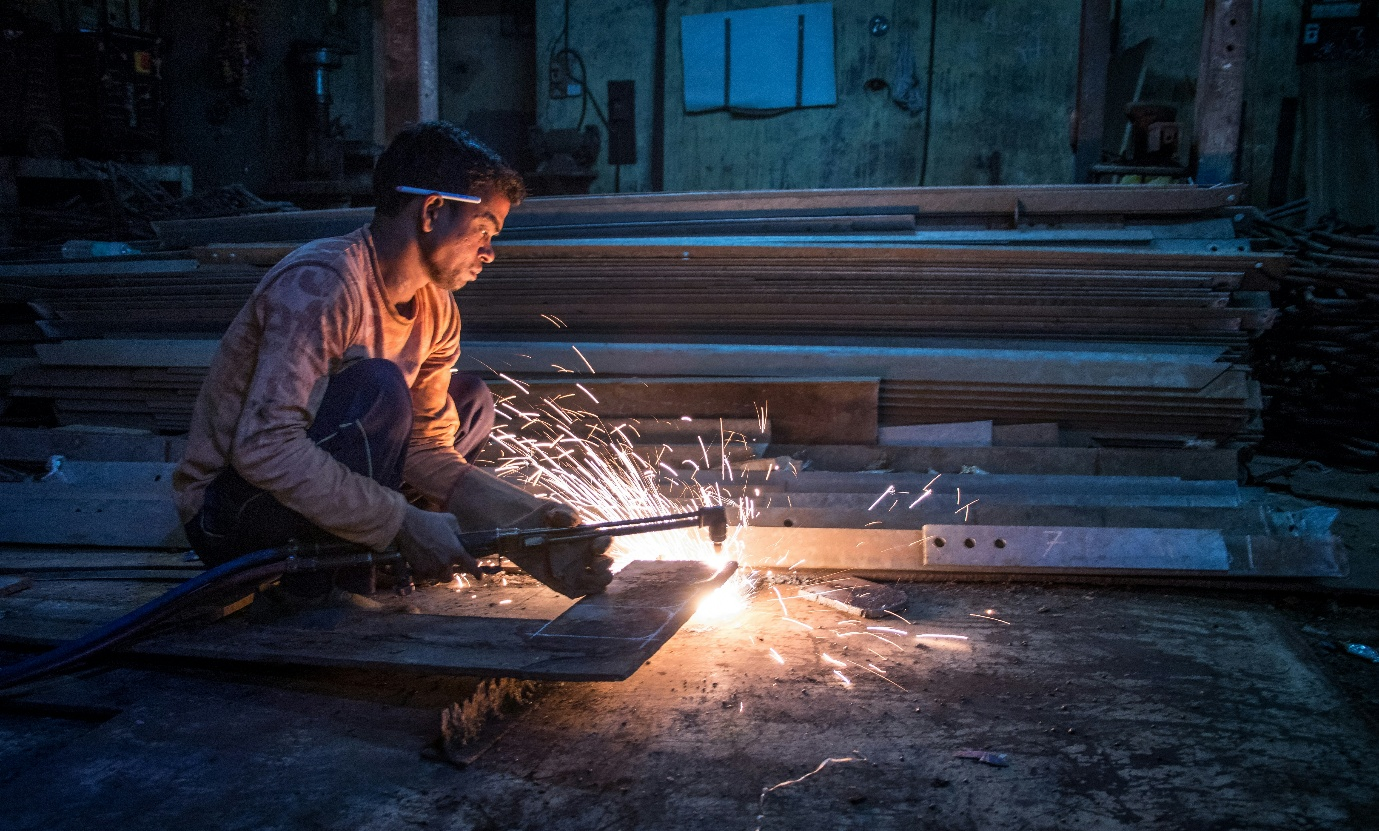
A product team in Germany or Japan does not need to build every capability internally. It can rely on a surrounding industrial fabric that already understands tolerances, material behaviour, revision discipline, quality documentation, and repeatability. India has pockets of such excellence. What it does not yet have, in many categories, is enough of it, close enough together, operating at the speed and precision that technically ambitious products demand.
India is often capable of making something once. The harder challenge is making it repeatedly, predictably, and at the quality bar expected of a premium global product. That is the gap.
Why the Part from Shenzhen Wins Every Time
The comparison with China is uncomfortable, but necessary. Shenzhen does not win merely because labour is cheap. That explanation is outdated and incomplete. It wins because its ecosystem has been forced to become better, faster, and more specialized through decades of intense demand and competition.
Thousands of component makers, tool rooms, electronics assemblers, plastics vendors, motor suppliers, and sub-system specialists operate within a tight industrial radius. They compete aggressively. They have seen similar designs before. They understand why a tolerance matters. They often begin the conversation not by asking what a component is, but by suggesting how to improve it, reduce cost, or shorten the development cycle.
A product team in India may spend weeks identifying a vendor capable of understanding a requirement. A product team in Shenzhen may begin with three vendors who already make adjacent versions of the same part. That difference compounds. Every design iteration completed in one week instead of one month accelerates product learning. Every delayed prototype delays engineering judgement. Every poorly made sample misleads decisions.
China built an environment in which hardware companies can learn quickly. India still forces many hardware companies to learn slowly and pay heavily for the privilege.
Volume without Value
India needs to build components before it obsesses over final products. The real economics of sophisticated goods live inside the parts: motors, sensors, power electronics, mechanisms, chips, optical systems, filtration materials, precision assemblies, and specialized components. A strong component ecosystem serves thousands of downstream products. A weak one turns every ambitious product company into an importer.
India also needs to build the machines that build everything else. Precision tools, automation systems, molding lines, test equipment, process-control machinery, and industrial platforms are not glamorous businesses. They do not always produce fashionable headlines. But they underpin every advanced manufacturing economy. A nation that does not build its own industrial tools remains structurally dependent on those that do.
India needs a generation of product owners, not only executors. People who define systems, not simply implement instructions. People who write specifications, file patents, design architectures, create differentiated products, and own the consequences commercially. The country has already produced world-class talent. It now needs more of that talent to build physical products with original intent.
And India needs to move faster. Hardware speed is not simply a founder virtue. It is an ecosystem outcome. When tooling takes months, prototype vendors miss drawings, logistics damage parts, and critical components are perpetually imported, iteration slows. Innovation slows with it. India needs the ability to move from concept to reliable hardware quickly, predictably, and repeatedly.
The Country Pulling Up to Its Own Table
UPI did not happen by accident. It happened because a group of people decided that India should own the infrastructure through which a billion people exchange money. They built it with Indian insight, Indian design, and Indian ambition. It became a platform that changed consumer behaviour across classes, cities, and industries. The value stayed because the architecture stayed.
That same spirit is beginning to appear in hardware. Quietly, in workshops and labs across Bengaluru, Pune, Chennai, Hyderabad, and beyond, founders are solving problems once left to foreign suppliers. They are identifying which components can be sourced locally today, which need to be imported for now, and which parts of a product can be redesigned entirely so the same functional outcome is achieved through a route better suited to Indian manufacturing realities.
This is the context in which Chewie is being built. Not in spite of India’s manufacturing constraints, but in direct response to them. Chewie is a hardware product designed for an Indian problem: total wet-waste management at home, without smell, mess, manual stirring, or compromise. It is built on original product thinking and original intellectual property. It refuses to treat the Indian consumer as the end-point for a watered-down product engineered elsewhere.
That choice is harder. It is slower in the short term. It asks more of vendors, more of engineers, more of capital, and more of patience. But it is the only route that creates enduring capability.
Every Indian hardware company that commits to quality, absorbs the cost of an immature supply chain, and stays in the market long enough to prove the commercial case makes the journey easier for the next one. It creates a reference point suppliers can price against, an example logistics firms can design around, and evidence investors can understand. The infrastructure tax is real. But it is not fixed. It reduces each time someone pays it and survives.
Water, Water Everywhere, Nor Any Drop to Drink
India has manufacturing everywhere. Industrial parks, assembly lines, vendor directories, export ambitions, policy announcements, and confident claims of becoming the next global factory floor. On paper, there is abundance.
Yet for a company attempting to build a serious, original hardware product, the experience can feel strangely barren. There are suppliers, but not always capability. There are factories, but not always precision. There are vendors, but not always ownership of quality, speed, or engineering intent. There is manufacturing all around us, and still, too little of the kind a product builder can reliably drink from.
That is the grime of the ancient manufacturer: a system old enough to know better, large enough to promise much, but too often trapped in inherited habits. It can produce. It can assemble. It can fulfil. But when asked to stretch, co-develop, refine, document, iterate, and meet a world-class product bar, too much of the ecosystem still recoils into delay, compromise, and familiar mediocrity.
This is not a condemnation of Indian manufacturing. It is a demand for its next evolution.
Because the future will not belong to countries that merely host factories. It will belong to those that build industrial depth: components, tooling, materials, process discipline, design ownership, and the stubborn ability to turn hard ideas into reliable products at scale.
This is the context in which Chewie is being built. Not as a shortcut around India’s manufacturing limitations, but as a product that chooses to confront them. Chewie is designed for an Indian problem, built through original engineering, and developed in a domestic ecosystem that must be pushed, trained, and upgraded along the way. That path is slower. It is less comfortable. It costs more in the short term. But it creates something assembly never can: capability.
Every serious Indian hardware company that refuses to settle for imported thinking and superficial local assembly makes the next one slightly easier to build. It creates better vendors, better expectations, better reference points, and better industrial memory. That is how an ecosystem changes. Not through slogans, but through repeated commercial insistence that better is possible and non-negotiable.
India has manufacturing in abundance. What it needs now is manufacturing that nourishes its own product ambition.
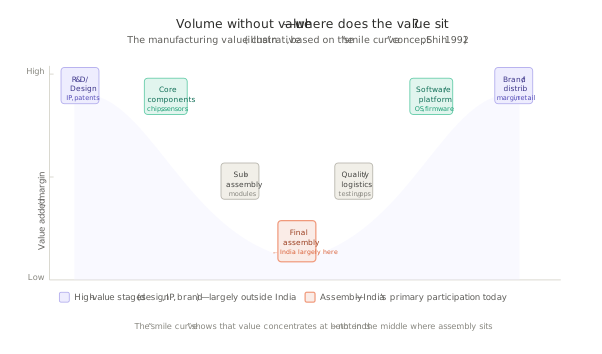
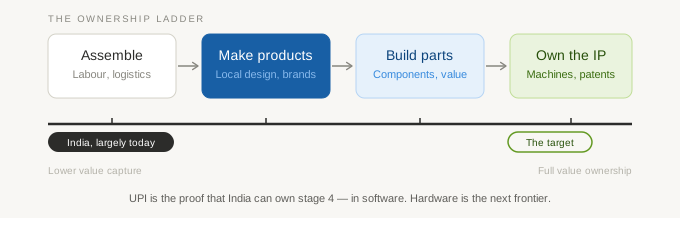
India is now among the largest manufacturing economies in the world by output. That is meaningful progress. It deserves recognition. But output alone does not answer the more important question: where does the value sit?
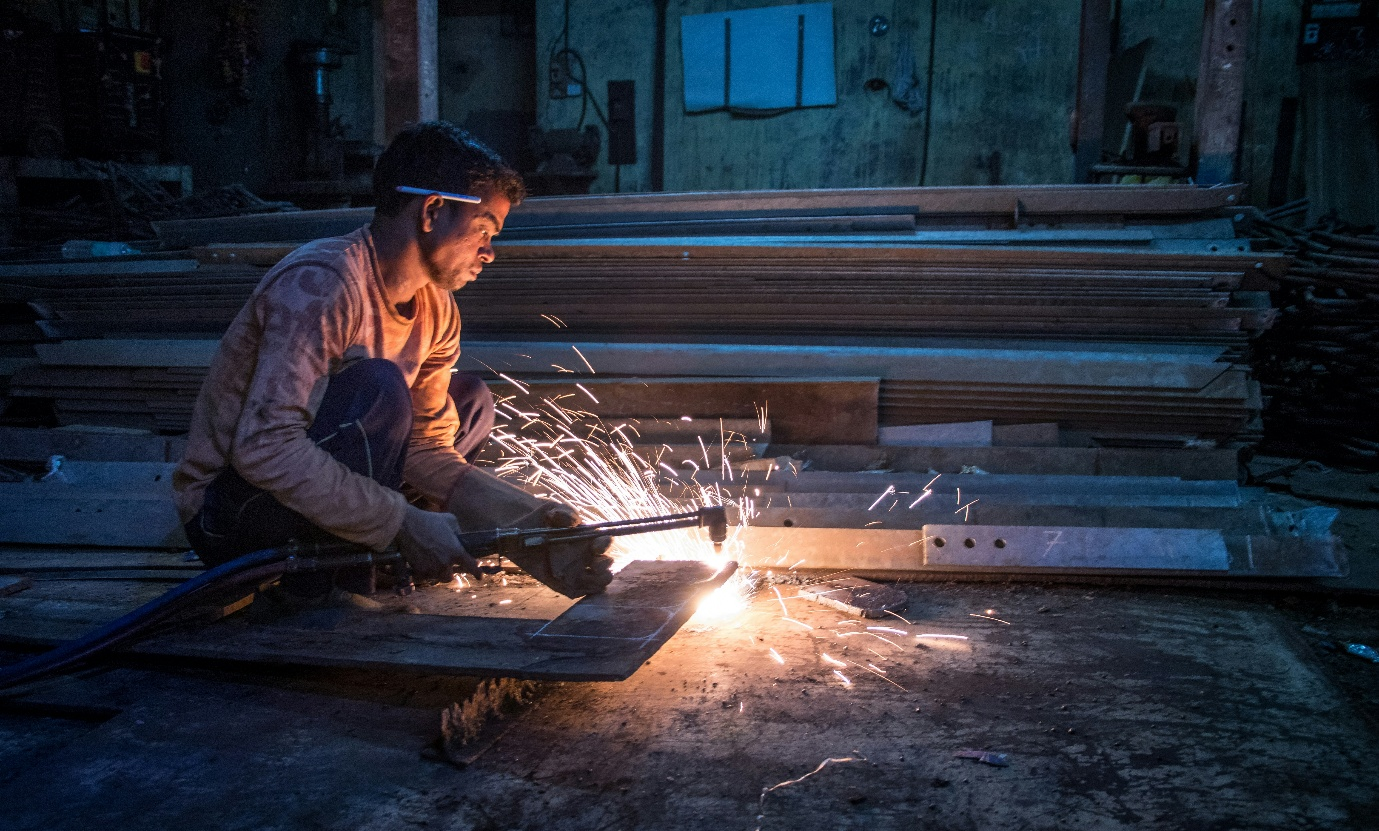
Take mobile phones. India assembles millions of them every year, over 30 million units in FY2023-24 alone, making India the world’s second largest mobile phone producer by volume (India Cellular and Electronics Association). This creates employment, strengthens process discipline, and builds scale. But the highest-value layers largely sit elsewhere. The chips, display modules, camera optics, sensors, core firmware, operating systems, and much of the production equipment originate outside India. The country participates in the manufacturing chain, but it does not yet control enough of the economic and technological value inside it.
The country that assembles the phone does not necessarily own the economics of the phone.
Assembly is useful. It is not sufficient. The deeper prize lies in components, capital equipment, original product architecture, and intellectual property. That is where margins are stronger. That is where know-how compounds. That is where strategic leverage sits.
A country does not achieve industrial sovereignty by assembling someone else’s product, from someone else’s parts, on machines imported from somewhere else. It achieves sovereignty by owning progressively more of what makes the product possible.
The Competitor Who Must Not Be Named
India’s biggest competitor in manufacturing is not always a foreign country or a global conglomerate. It is inertia.
It is the quiet belief that things have always been done a certain way, and therefore need not be done differently now. This belief lives in vendor negotiations, in the reluctance to invest in tighter process control, in casual attitudes toward documentation, in logistics systems that treat precision-engineered parts like generic cargo, and in manufacturers who prefer familiar methods even when those methods are no longer enough.
This is not a talent problem. India has extraordinary engineers, machinists, operators, and entrepreneurs. It is an incentive problem. For decades, much of the ecosystem has been rewarded for reducing cost, not for building capability; for fulfilling orders, not for helping create categories; for staying safe, not for stretching into higher-precision work.
The services economy filled a large part of this vacuum. India became world-class in IT services, finance operations, legal services, recruitment, compliance, and business-process support. These are real strengths. But physical product building requires a different muscle. It requires people who define the problem, write the specification, design the system, file the patent, build the supply chain, and own the commercial outcome.
That shift is beginning. But it is far from complete.
The Market India Has to Invent
China solved part of its domestic manufacturing challenge by creating protected demand in key sectors, allowing local capability to mature before being exposed to full global competition. India cannot replicate that route cleanly, and perhaps should not. But the underlying question remains urgent: how does India create a durable market for Indian-designed, Indian-made hardware when imported alternatives are often cheaper, faster, and backed by more mature ecosystems?
There is no single answer yet. Production-linked incentive schemes help. Government procurement preferences help. Strategic sectors such as defence and space help. But these mechanisms alone cannot create a broad culture of product ownership across consumer and industrial hardware.
India needs commercially compelling products that are not merely “made in India” at the assembly level, but conceived from Indian problems, engineered from first principles, and good enough to earn demand without patriotic discounts.
UPI offers a useful reference point. It did not succeed because it was Indian. It succeeded because it solved a real Indian problem with extraordinary clarity, interoperability, and scale. It created a new behavioural default. By FY2024-25, UPI was processing over 172 billion transactions annually, accounting for roughly 46% of all real-time payment transactions globally (NPCI/ ACI Worldwide). Hardware needs its own equivalent. Not a copy of UPI, but the same level of ambition: products and systems where India is not merely the executor, but the originator of the category logic.
What It Actually Costs to Build to German Standards Without German Infrastructure
When an Indian hardware company attempts to build to global standards, it often finds itself doing two jobs at once. The visible job is building the product. The invisible job is recreating portions of the industrial ecosystem that should already exist around it.
This means developing vendors rather than simply selecting them. It means building internal test rigs that should be available as external services. It means performing tighter incoming quality checks because supplier consistency cannot always be assumed. It means redesigning parts around domestic manufacturability, holding more inventory because reliability is uncertain, and spending disproportionate time on documentation, traceability, and revision discipline.
A premium hardware company in India does not bear only product-development cost. It bears ecosystem-development cost. This is the tax on ambition.
A German company benefits from German industrial depth. A Japanese company benefits from Japanese supplier maturity. An Indian company aiming for the same product standard often has to subsidize the capability gap itself. That is why serious hardware building in India can appear slower and more expensive than outsiders expect. The product is not the only thing being built. The enabling industrial layer is being built in parallel.
What Is Being Done, and Why It Matters More Than It Looks
Despite these constraints, something important is shifting. Defence startups are indigenizing systems once assumed to be permanently import-dependent. Space-tech companies are producing sophisticated hardware in Bengaluru and Hyderabad. Semiconductor design firms are generating Indian intellectual property even when fabrication still happens offshore. Electric vehicle companies are pushing suppliers to move faster than they are comfortable moving, and under that pressure, some of those suppliers are beginning to evolve.
These companies share a common method. They are not merely consuming the ecosystem. They are upgrading it through demand.
Every time a demanding Indian customer asks a vendor to hold a tighter tolerance, document a process, improve a finish, shorten a lead time, or build a more reliable component, the ecosystem shifts slightly upward. That improvement does not disappear after one order. It becomes embedded in the vendor’s capability. The next hardware company inherits a marginally better industrial environment than the one before it.
This is slow compounding. But it is compounding.
What India Actually Needs to Build
-
India’s New Wet Waste Rules, Explained: What Every Urban Household Needs to Know

What Are the SWM Rules, 2026?
India’s Ministry of Environment, Forest and Climate Change (MOEFCC) has issued the new Solid Waste Management (SWM) Rules, 2026, which replaced the earlier 2016 framework. The new rules were enforced from April 1, 2026, and apply to every waste generator such as households, residential societies, offices, commercial establishments, and governing authorities.
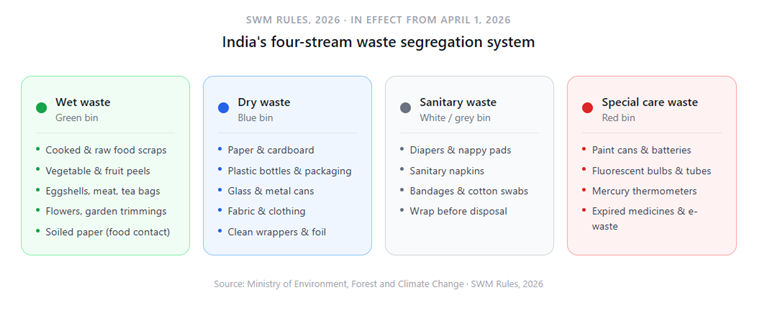
The single biggest change is the shift from a two-stream segregation system to a mandatory four-stream segregation system. Until now, most cities relied on a two-bin model (wet and dry). The new rules add two more categories, making the system more precise about what goes where.
The Four Bins: What Goes Where
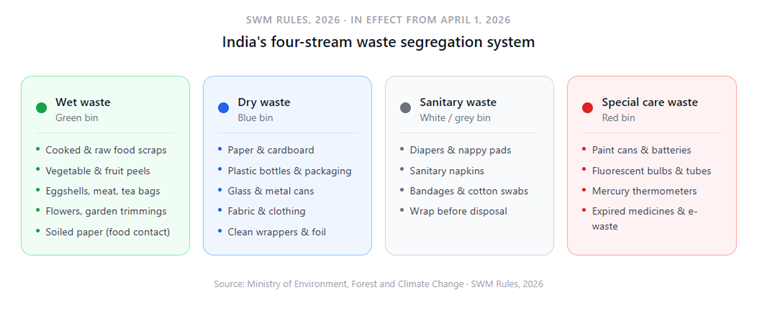
Here is how the four streams are defined under the new rules:

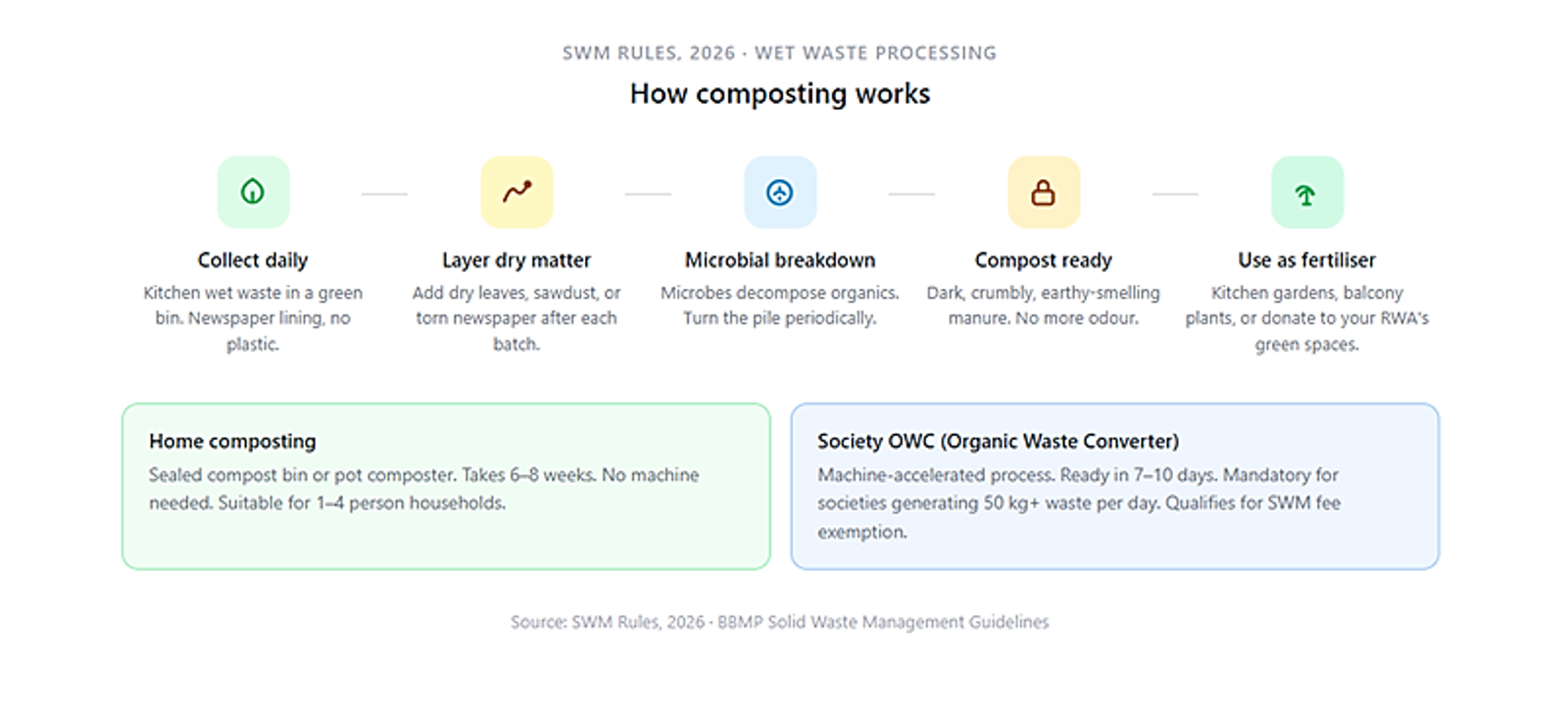
Under the SWM Rules, 2026, wet waste must be composted or processed through bio-methanation wherever feasible. For most urban households, this would mean managing their wet waste individually.
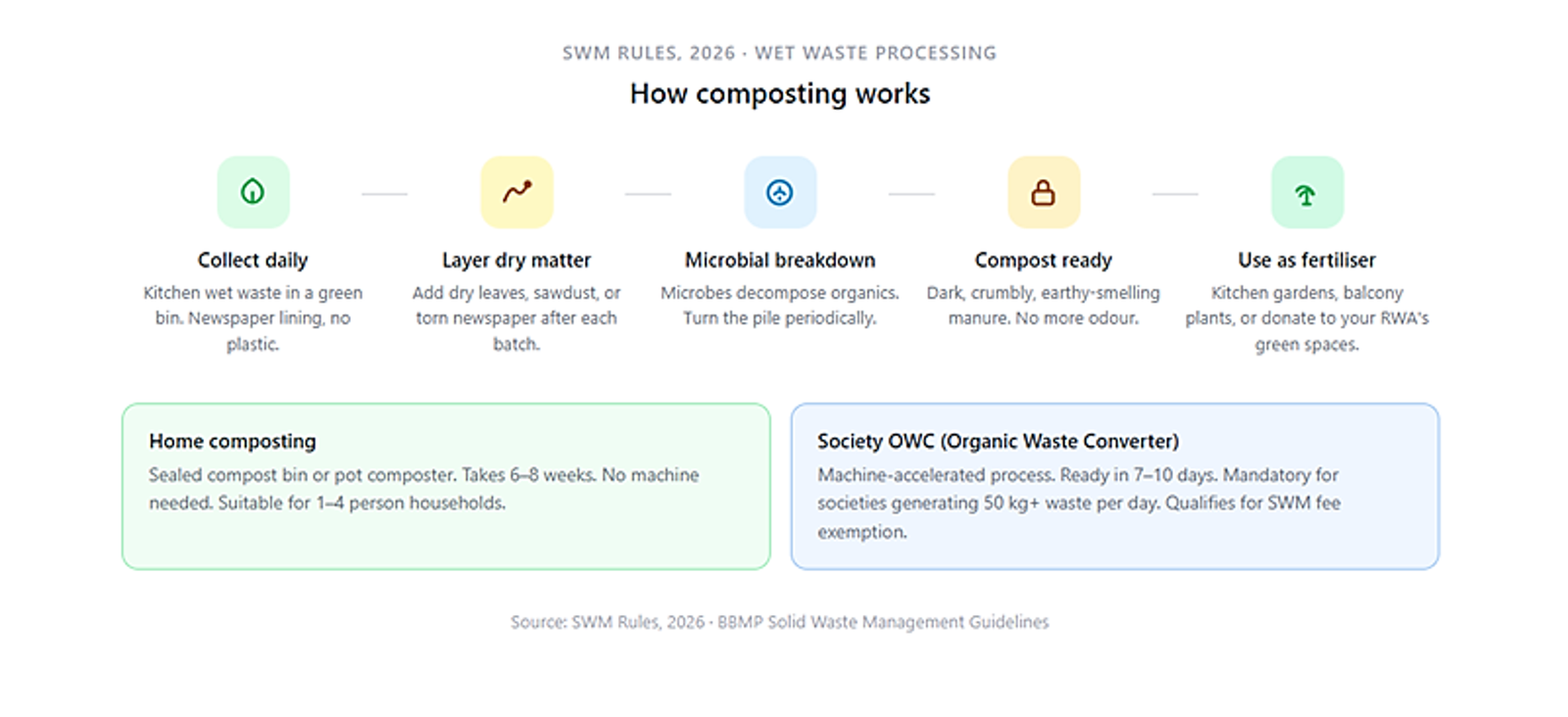
Home composting involves collecting wet waste in a sealed container or compost bin, layering it with dry matter such as dry leaves, newspaper, or sawdust, and allowing microbial action to break it down over 6-8 weeks into nutrient-rich compost. The result can be used directly in kitchen gardens or balcony plants.
Community or society-level composting uses Organic Waste Converters (OWCs). These are essentially machines that accelerate the breakdown process. A standard OWC can convert wet waste into manure in 7–10 days. Residential societies that generate more than 50 kg of waste per day are required to install and operate an OWC or equivalent on-site.
For societies that compost successfully and route dry waste to authorised recyclers, there is a significant benefit: exemption from the SWM service fee charged by the urban local body. They can apply for an exemption from the SWM fee thus providing a direct financial incentive for societies to invest in OWCs.
Rules Specific to Bengaluru (GBA)
Bengaluru’s civic authority, previously the Bruhat Bengaluru Mahanagara Palike (BBMP), has been one of India’s more active enforcers of waste segregation rules, and the 2026 framework strengthens the regulations that were already in place.
Households in Bengaluru: Every household must hand over waste already segregated into the appropriate streams. The collection vehicles have separate compartments for wet and dry waste. If you hand over mixed waste, the collection vehicle is authorised to refuse pickup. The responsibility to segregate the waste is entirely on the generator and not on the worker at your gate or at the facility.
Bulk Waste Generators (BWGs) in Bengaluru: Under BBMP’s 2025-26 framework, BWG classification differs by property type. For residential properties: a property qualifies if it has 100 or more apartment units, or generates 100 kg or more of solid waste per day (BBMP circular, 2022). For commercial and industrial properties: additional criteria include a floor area of 20,000 sq. metres or more, or water consumption of 40,000 litres per day or more (SWM Rules 2026). Most mid-to-large apartment complexes fall into the residential BWG category.
A 400-unit apartment complex can generate about hundreds of kilograms of wet waste every single day.
BWG properties in Bengaluru now operate under a per-kilogram pricing model for wet waste, replacing the previous fixed annual charge. And once penalties increase, communities will increasingly optimize for three things:
-
Lower waste handling costs
-
Lower operational friction
-
Lower compliance risk
If a BWG property manages its own wet waste and routes dry waste through appropriate recyclers, it can apply for an exemption from the SWM fee.
This changes how waste solutions are evaluated. Earlier, sustainability products were treated like moral purchases. Now they are increasingly infrastructure purchases.
Closer to air purifiers, water softeners, or backup power systems. Not symbolic. Functional.
The Polluter Pays Principle Is No Longer Abstract
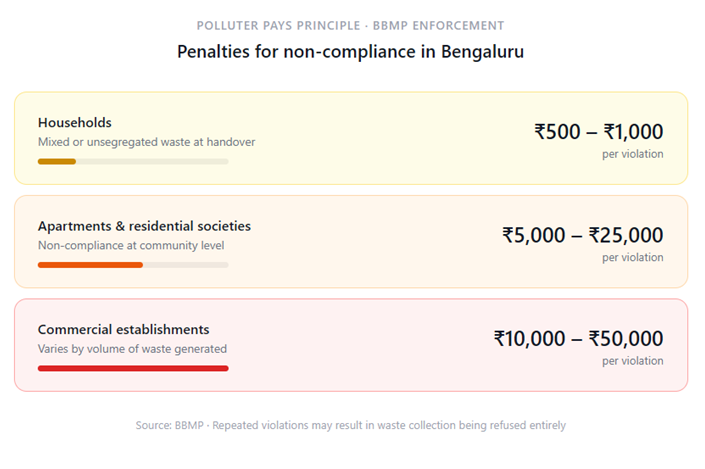
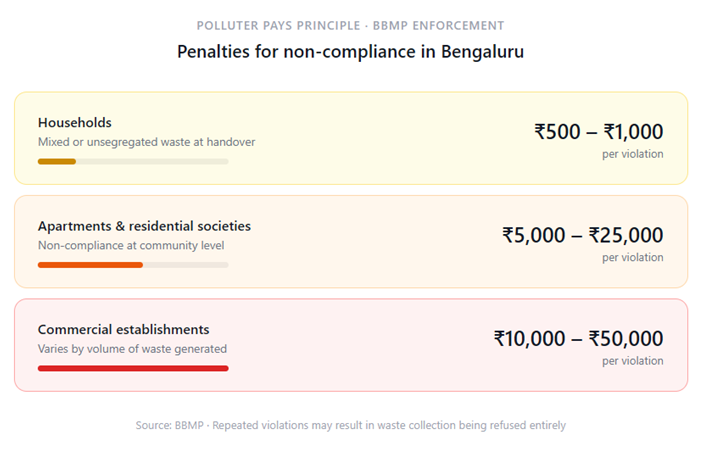
SWM Rules, 2026 operate under the “polluter pays” principle and non-compliance attracts environmental compensation. In Bengaluru, the penalty structure is as follows:
-
Households: ₹500 to ₹1,000 per violation for handing over mixed or unsegregated waste.
-
Apartments and residential societies: ₹5,000 to ₹25,000 per violation.
-
Commercial establishments: ₹10,000 to ₹50,000 depending on the volume of waste generated.
Beyond fines, repeated non-compliance can result in waste collection being denied entirely which, opens a completely different can of worms for housing societies and their residents.
Bengaluru has already seen what happens when frustration around waste reaches a tipping point.
One of the city’s most memorable civic protests was the “Kasa Surisuva Habba” initiative, loosely translated as “festival of dumping garbage.”
The movement emerged during periods of severe waste-management breakdowns in the city, when residents protested illegal dumping and poor municipal handling. This was tackled by returning the garbage to the respective individuals, authorities or establishments. What made the campaign resonate was not just the spectacle by itself, but the message:
Waste does not disappear just because it leaves your threshold.
The Four-Bin Rule Is Really About One Thing
The headlines focus on the number of bins. Green, blue, red and black. But the shift is more behavioural.
India is slowly moving from centralized dumping toward decentralized accountability.
The government’s revised rules also include phased implementation timelines because cities require time to upgrade current collection systems, improve transport infrastructure, and overhaul disposal mechanisms. Reports on implementation reference transition periods ranging from six months to longer phased adoption windows depending on local bodies and operational readiness.
That gap between policy and infrastructure is where most urban frustration currently sits. People are being asked to participate in systems that are still evolving.
But this transition phase also reveals something important:
The most future-ready homes will not be the ones waiting for perfect municipal infrastructure. They will be the ones reducing dependence on it altogether.
What You Should Do Now
If you haven’t already, here is a practical starting checklist for urban households:
-
Set up three or four bins at home: A small wet waste bin lined with newspaper, not plastic, a dry waste bin, and a bag or container for sanitary and hazardous items.
-
Empty the wet waste bin daily or at least every alternate day: Wet waste left for more than two days begins to smell and attract pests.
-
Consider an on-site wet waste solution. Chewie is an AI-powered appliance designed for urban Indian kitchens with no manual stirring, no odour, no pest risk. It converts your wet waste into Regen Soil automatically. Traditional home composting systems are also available for households that prefer a manual approach. BBMP has offered subsidies in the past for residents who adopt on-site composting; check with your ward office for current schemes.
-
For society residents, check if your RWA has an OWC: If not, raise it at your next general body meeting. The exemption from SWM fees can offset the installation cost within a year for most mid-size societies.
-
Do not put wet waste in plastic bags: Use newspaper, compostable bags, or, no liner at all. Plastic liners defeat the purpose of wet waste segregation and often end up as a contaminant in large composting facilities.
India’s SWM Rules, 2026, represent the most significant update to waste management law in a decade. For urban households, your responsibility is clear: separate your wet waste from everything else, and hand it over in a condition that allows it to be composted. The four-bin system is now being enforced, penalties are being levied, and cities like Bengaluru have both the enforcement infrastructure and the financial incentives in place to make compliance the norm rather than the exception.
“Bin There, Dump That” Only Works If There’s Somewhere to Dump
India’s waste conversation still assumes that waste is someone else’s responsibility. Someone else will collect it, sort it, process it and dump it somewhere outside the city.
But everyone seems to ignore a harsh truth: every city is running out of “somewhere else.”
Landfills are politically volatile. Transport costs are rising. Segregation enforcement is increasing because municipalities cannot sustain mixed waste streams indefinitely.
So how does that change the role of the modern kitchen? The kitchen is no longer just where waste begins. Increasingly, it is also where waste must end.
The households that will suffer least under stricter waste enforcement are the ones least dependent on municipal systems.
1 Penalty amounts cited are based on BBMP’s published bye-laws and documented enforcement actions. These are Bengaluru-specific rates; the SWM Rules 2026 delegate exact fine-setting to State Pollution Control Boards, so amounts may differ in other cities and are subject to revision. Verify current rates at bbmp.gov.in or with your local ward office before publishing
2 For the latest updates on BBMP waste rules and composting subsidies, check the BBMP official website or your ward office.
-
Wet waste (green bin) – Kitchen and organic waste. This includes cooked and uncooked food, vegetable and fruit peels, meat, eggshells, flowers, garden trimmings, and tea leaves. Anything that was once biological and will decompose. This stream is routed to composting, bio-methanation facilities, or perhaps, Chewie.
-
Dry waste (blue bin) – Recyclable materials that are clean and dry. Paper, cardboard, plastic bottles, glass, metal cans, and fabric. These go to Material Recovery Facilities (MRFs) where they are sorted and sent to recyclers.
-
Sanitary waste (white or grey bin) – Used diapers, sanitary napkins, bandages, and similar hygiene products. These must be wrapped separately before disposal and are not mixed with wet or dry waste.
-
Special care waste (red bin) – Hazardous household items such as paint cans, fluorescent bulbs, mercury thermometers, expired medicines, batteries, and electronic waste. These are collected at designated drop-off centres.
On paper, this makes perfect sense. It is the right thing to do. You’re adhering to the rules, respectful of people working in the facilities and stand on moral ground that you are doing the best you can for the environment. But in practice, the friction of segregation starts immediately.
In a household that runs on schedules such as school runs, early calls and domestic staff rotations, waste segregation is one more system that needs to work without thought. Collection timings shift. A family member uses the wrong bin. By 9 AM, the kitchen already feels like it’s failing a compliance audit.
And then comes the question almost everyone quietly asks: If the collection truck still mixes some of it later, why am I doing all this? Would mixing the wet and dry waste together get noticed? Would today be the day my waste is rejected and I get fined?
Urban professionals really do live life on the edge. But, the direction of this policy is also clear.
Cities are steadily moving toward decentralized accountability because centralized mixed-waste handling has failed repeatedly. The burden is slowly shifting upstream, toward homes and communities.
What Exactly Counts as Wet Waste?
Wet waste is the largest contributor by volume in most Indian households, and also the most likely to cause problems if handled incorrectly.
Wet waste includes:
-
Raw and cooked food scraps
-
Vegetable and fruit peels and seeds
-
Leftover cooked food (dal, rice, roti, curries)
-
Eggshells and meat scraps
-
Tea bags and coffee grounds
-
Flowers and plant trimmings from home gardens
-
Soiled paper (paper used to wipe food)
Wet waste does not include:
-
Oily food wrappers or plastic packaging (these go in dry waste)
-
Sanitary products (separate bin)
-
Broken crockery or glass (special care waste)
The key test is simple: if it was once organic and will rot, it is wet waste.
Why Segregation at Source Matters
The new rules place legal responsibility rightly on the waste generator meaning you, as a household. The principle applied is “polluter pays“: if you hand over unsegregated waste, you are responsible for the downstream cost and harm that causes.
When wet and dry waste are mixed together, several things go wrong. Recyclable materials get contaminated and cannot be processed any further. Organic waste generates methane in landfills, a greenhouse gas far more potent than CO₂. Processing costs for urban local bodies go up significantly. And landfills, that are already overfull in most Indian cities, fill up even faster, flashing glimpses of a possible Wall-E future.
Segregating waste at home is the one of the most impactful and environment friendly steps an urban household can take.
How Does Composting Work and What Do the Rules Mandate?


-
-
Patriotism Is Having Power Backup: The Generator Generation

At 7:42 a.m., in a glass apartment in Bangalore, patriotism sounds like a click.
Not the ceremonial click of a camera at a flag-hoisting. Not the click of a TV remote settling into a prime-time argument. A smaller, more honest click: the inverter switching over, seamlessly, when the electricity decides it needs a break.
The coffee machine does not hesitate, the Wi-Fi stays alive, and the work call continues. And somewhere along the way, that small refusal to be interrupted stopped being about electricity. It became a way of thinking.
The ongoing LPG crisis made the same point in a different register. PG kitchens cut back or shut temporarily, restaurants and hotels either raised prices or paused service, homes waited longer for cylinders, and yet life did not stall for long. People improvised, shifted fuels, adapted routines, and found workarounds almost overnight. Everyday life regained its rhythm with startling speed. That is one of India’s most underappreciated strengths: not the absence of disruption, but an extraordinary civic instinct to absorb it, adjust, and keep moving.
Reliability as Patriotism
Not too long ago, on national television, a panelist tried to puncture a founder’s talk of patriotism with a line that drew the usual laughter: “there is no point being patriotic if you cannot even keep the lights on in your office”.
It was meant to sound hard-headed. It was meant to expose sentimentality. But, it accidentally revealed something else: a fault line in modern India. Not between left and right. But, between two kinds of citizens.
The first kind sees failure and draws a conclusion: leave. The second sees failure and asks a different question: what do I need to build so life does not remain hostage to it? That second instinct is producing a new kind of Indian citizen. Let’s call them the ‘Generator Generation’.
This shift from escape to ownership may begin with those who can afford to choose differently, but it doesn’t belong to them alone. The generator generation is here to build that shift. Because, once you stop outsourcing inconvenience, you start noticing where else you’ve been outsourcing responsibility.
The Shift From Escape to Build

Alongside this, there was another quiet unfolding. A generation that grew up exposed to global systems, lifestyles, and standards. They internalised a simple idea: things can work better, even in India.
An Indian stand-up comedian once remarked that the big cities in India are either full of NRIs or full of people who want to be NRIs. It captured a culture in which success meant leaving home. Settled abroad was not a biographical detail. It was a status upgrade.
But, that joke is getting old.
What looked like global modernity often felt like distance, from community, from culture, from a sense of place. The return-to-India story, then, is not only about salary. It is about fit.
Many who left are returning. Many who once wanted to leave no longer romanticize it. Many who never left no longer feel obliged to explain themselves.
Call them ex-NRIs. Call them global Indians. Call them the post-visa class. Sometimes we love to call them “coconuts”: brown on the outside, white on the inside. The label matters less than the behaviour.
Even the coconuts are choosing India. Not out of sacrifice. But, out of self-interest. (Coconut and proud, No Cap!)
They want their children near grandparents, not just on scheduled video calls. They want to belong without the hassle of paperwork. They want cultural continuity without asking for permission to exist. They want opportunity without living permanently as a guest. And they have reached a blunt conclusion: they do not need a perfect system to build a great life. They can engineer their way into one.
That is the real meaning of the generator now.
The Generator Generation
In older India, a generator was an apology. Loud, fuel-hungry, inelegant proof that the grid had failed again. But, in this India, a generator is also a statement: I will not let dysfunction dictate the terms of my life.
The Generator Generation does not wait for clean water. It installs purification. It does not wait for clean air. It buys filtration. It does not wait for uninterrupted power. It does not wait for public services to catch up before deciding what normal should feel like at home.
Once enough households stop participating in survival mode, the baseline shifts. Standards become high. Markets are pushed to change and companies get built differently.
One inverter does not fix the grid. But a generation that refuses outages changes what outages are allowed to be. That is how real cultural change happens. Not only through law or speeches, but through the pressure of expectations.
And this expectation is not limited to electricity. A nation reveals itself not in what it celebrates, but in what it does with its discards.
What the Kitchen Reveals
If you want the truth about a country, do not begin with slogans. Begin with its sinks.
Wet waste is where infrastructure stops being a policy and becomes personal. It exposes a deeper habit: do we, as citizens, take responsibility at the source, or do we push the mess into someone else’s life and call that practicality?
India’s default answer has long been simple: out of sight, out of mind. Put it in a bag. Wrap the problem up and hand it to someone else. Let it disappear. Let “outside” deal with it. But outside is not a magic zone. It is someone else’s street, someone else’s lungs, someone else’s labour, everyone’s landfill.
The cost never disappears. It merely changes address.
And yet, even here, where the problem is visible, behaviour does not stick.
The Misreading: The Investor Paradox
From the outside, this gets misread. When behaviour does not stick it is easy to assume people do not care. This is where the familiar Indian gatekeeping cynicism enters the room.
“Indians will not pay for this”. “Indians do not care”. “The city is dirty anyway, so why bother?”
The most revealing version of that sermon came from some old school investors we had consulted before Mankomb was incorporated. One said that in India, even if people see a road accident, many keep driving, relieved it was not them. Why would they care about keeping the city clean? Another argued that if it is free to throw waste out the window, why would anyone pay to manage their own waste?
Then came the confession, almost always in the next breath: “I will be ordering a Chewie for my home. I need it. But you will not find too many people like me.”
The same class that doubts India’s civic behaviour privately purchases relief from India’s civic mess. They want cleanliness and hygiene inside their own walls while denying that the demand can scale beyond them. But, they are wrong.
The “India is poor” reflex is outdated. The “nobody pays for quality” stereotype is dying. There is a growing class of Indians who want premium, dependable, hygienic, modern products, and want them here.
The problem is not that people do not care. It is that systems demand too much from them, too consistently. And if that is the problem, then it is not a people problem. It is a design problem.
Designing for Reality
Designing for behaviour like this means starting from a different premise. Not asking how to make people more disciplined. But asking what would happen if discipline was not required in the first place. Because the problem was never awareness.
It was the effort required to act on it, every single day. And effort does not scale.
What would it look like to build a system that works even when people are busy, distracted, or inconsistent?
One that does not depend on reminders, routines, or motivation? One that simply works, quietly, in the background?
Operational Patriotism
People are tired of living like tenants in their own cities. They are tired of treating inconvenience as fate. They want agency. Dignity. Convenience without guilt.
This is where Chewie fits the moment.
Not as a hobbyist composter. Not as a green guilt-reliever. Not as a decorative gadget for rich kitchens. But, as infrastructure. Its premise is plain: your wet waste is your responsibility. Not the housekeeper’s. Not the municipality’s. Not the landfill’s.
That sounds inconvenient until the inconvenience is removed.
Set it and forget it. No stirring. No smell. No pests. No daily negotiation with a bin that feels like a moral tax.
In cities where premium consumers already buy RO systems, air purifiers, robot vacuums, smart locks, and every conceivable device that buys time and control back, wet waste remains one of the last ugly, unresolved domestic failures. Chewie does not sell “composting.” It sells hygiene at the source.
It sells control, cleanliness, dignity and the right to not outsource stink and moral discomfort to someone else.
That is why the patriotism argument works, but only when framed correctly. Not as chest-thumping. Not as a sentiment. Not as a demand that people love India despite its failures. But, as operational patriotism.
Patriotism Beyond the Labels
The old patriotism was often performative: loud, symbolic, emotionally satisfying, and operationally useless.
The new patriotism is quieter. Harder. More expensive. It looks like maintenance. It looks like competence. It looks like standards. It is not saying “India is great.” It is behaving like India will be great, and working towards it accordingly.
That means refusing to normalize decay. Refusing to externalize the consequences of convenience. Refusing to build private comfort on public filth. Refusing to treat civic collapse as a permanent feature of Indian life.
A confident country is not one whose citizens insist it is already perfect. A confident country is one whose citizens behave like greatness is possible and begin building the conditions for it. Keep the lights on. Buy that back up. Build redundancy. Run your home like a system that deserves reliability.
But do not stop at electricity. Because the generator was never the point. The point was what the generator represents: a citizen who refuses to be held hostage by what is not fixed yet.
So, when the next generation looks at your home, will they see a family that merely lived in India, or one that took ownership of India?
What kind of Indian are you?
For decades, the script of Indian aspiration was simple: study hard, get out, settle abroad, send money back, return for weddings, complain about “the system” in India, and praise “systems” elsewhere. India was the internship. The West was the full-time job.
It was not always snobbery. The brain drain was not a betrayal. Often, it was the justified ROI.
But the math has changed. Not because India became perfect or because the West became evil. It did not. But because the West stopped delivering what it promised, and India stopped being condemned to what it once was.
The foreign dream, for many, became a bundle of compromises. Wearing luxury as a costume: visas as suspense, healthcare as financial risk, loneliness disguised as independence, high rent marketed as opportunity, and the constant feeling that you are welcome only so long as you are useful.
At the same time, India produced something it did not have at scale before: a large and visible class that can pay for quality and refuses to apologize for wanting it. This part matters because India did not just get richer, it got less resigned. Ownership began to look more attractive than escape.
The Return and the Realisation

-
“Sustainable Living” or as Our Ancestors Used to Call It, “Living”

Sustainability, today, needs to be discussed in the context of a world that is changing faster than ever before. As cities grow, lifestyles accelerate, and technology reshapes how we live and consume, there has been a quiet shift happening in many urban homes today.
On one side sits the idea of sustainability. Reusable everything. Composting. Conscious consumption. Buy less. Waste less. Live lightly on the planet.
On the other side sits the reality of urban life. Long commutes. 10-hour workdays. Small apartments. Overflowing garbage bins. Appliances that mysteriously stop working just when the warranty ends.
Somewhere in the middle of this tug-of-war sits an invisible urban class, carrying an unseen burden: the expectation to “do better” for the planet while navigating systems that rarely make sustainable choices easy.
Sustainability Lives in Every Corner of Your Day
Here’s what I find most striking: sustainability isn’t a category. It doesn’t have a designated corner of your life where it lives. It exists everywhere around us.
The raagi mudde your mother made on a Tuesday evening with barely any processing versus the pizza order on a quick commerce app at 9:30 PM after a meeting that ran long. Both are real choices made by real people in the same city on the same night. The footprint difference between them is significant. Neither person is a villain.
The neem twig versus the thirty-step skincare routine with serums flown in from Seoul. The same sesame oil that Ayurvedic texts documented two thousand years ago is now amber-bottled, rebranded as “clean beauty,” and sold at a 1000% markup. We left home, dressed it up, and charged ourselves for the privilege of returning.
The small apartment in a walkable neighbourhood versus the 4,000-square-foot villa with four ACs running through every April. The bicycle versus the EV. The Kanjivaram that was never designed to go out of style versus the fast-fashion kurta that looked fine for one season and is now somewhere in a landfill in Tamil Nadu near the river that runs blue with dye.
The pressure cooker your mother bought in 1987 that still works versus the appliance engineered to fail just outside its warranty window.
Every single one of these is a choice. And those choices, added up across ten million households in one city, become the condition of the ground, the water, and the air that we all share.
The conversation around sustainability has been framed incorrectly for a long time. Not because the goal is wrong. The planet absolutely needs more responsible consumption. But the responsibility has been distributed unevenly, and the solutions offered often ignore how people actually live.
To understand sustainability today, we need to talk about the three groups that shape it.
The Economics of Sustainability: Who Can Afford What


Here is the truth that nobody in the sustainability conversation wants to say out loud.
The economically challenged have no choice but to be sustainable. The affluent have every choice to be sustainable. And the urban class, honestly, just doesn’t have the time.
In a village in northern Karnataka, a woman is brushing her teeth with a neem twig she broke off a tree by the road. She is not doing this because she read about Azadirachtin’s antibacterial properties in a wellness newsletter. She’s doing it because it’s free and it works. She cooks with whatever the season offers, wears clothes until they become dust, fixes things rather than replaces them, and returns her organic waste to the earth without thinking twice.
The point is not to celebrate constraint. The point is that embedded inside her life is a wisdom we have violently discarded and that the principles are worth recovering, even if the conditions are not.
On the other hand, something genuinely interesting is happening among India’s affluent. The senior director in Indiranagar with the built-in refrigerator and the wine cooler is also, quietly, putting solar panels on his terrace. His wife has replaced every plastic bottle in the home with copper and steel. They’ve switched to organic produce, not as sacrifice, but as a considered choice. They bought an EV because over ten years it makes financial sense, and also because they have a conscience and a child who asks questions. Their next home is being designed with passive cooling.
This is what sustainability looks like when you have the resources and the room to think. It’s not martyrdom.
The affluent can afford to be sustainable. But, do they mean it?
Then there’s the couple in Whitefield. Both in tech, toddler in daycare, EMIs on the car, the apartment, the washing machine. They leave at 7:30 AM. They return at 8:00 PM. They feel vaguely guilty every time they tie the kitchen waste bag. But the organic store is forty minutes away on Saturday, and the children have football practice, and there is a family lunch on Sunday, and by Monday morning the guilt has been fully displaced by their routine.
This is not failure. This is simple math. Twenty-four hours, minus work, minus commute, minus children, minus the ten things that broke this week, and there is simply no margin left for another system that requires attention.
Yet when conversations about sustainability happen, the pressure tends to land squarely on this same urban class.
Bring your own container. Stop wasting food. Separate your garbage. Choose greener products. All of these are good ideas. But they also assume something important: that people have the time, infrastructure, and systems that make these choices practical.
Often, they do not.
Sustainability Changes as You Change
When you are young and earning your first real salary, you are trying to figure out what your life can look like. You are comparing. You are upgrading. You want the phone your colleague has, the sneakers that get noticed, the restaurant that will photograph well. There is nothing wrong with this. It is the natural expression of someone who finally has agency over their choices and is testing the edges of that freedom.
But something shifts. It shifts for most people who have been fortunate, around their mid-forties and then the question changes. You’ve accumulated. The house is full of things. You’ve had four phone upgrades and genuinely cannot remember what feature the last one added. And you begin, quietly, to understand something your grandmother knew without being told: that what you actually want is less, but better. More intentional. Things that last. Experiences, not objects.
This, too, is sustainability. Not as an ideology. As maturity.
The young person optimises for the maximum they can afford and measures against their peers. The older person optimises for the maximum value with the minimum waste financially, ecologically, emotionally. They want the appliance that runs for twenty years. The fabric that doesn’t pull. The car they don’t need to replace. Interestingly, they are often willing to pay more upfront for the thing that costs less over time.
Sustainable choices are almost always more expensive in the short term and dramatically cheaper in the long term. Fast fashion is cheap until you add up what you’ve spent in five years. Cheap appliances engineered for planned obsolescence are affordable until the third replacement. This is not a coincidence. It is a quiet design philosophy embedded into many modern products. And it extracts from your wallet in exactly the same way it extracts from the earth.
The Sustainability That Already Existed
Many households in earlier generations were already practicing sustainability, even if they never used that word.
Think about it. Your grandmother did not need a podcast to tell her to be more sustainable. The steel dabba that held her tiffin was not a limited-edition product; it was just a box, used every day for forty years. Clothes were stitched, re-stitched, repurposed into dusters, and finally used to stuff a pillow. Nothing became nothing. Everything became something else.
This was not environmental activism. It was simply frugality and practicality.
But as cities grew and lifestyles changed, these systems slowly disappeared. Apartment living removed backyard compost pits. Repair culture declined. Convenience replaced patience. Packaging increased. Waste grew.
Today, the same urban families are being asked to “return” to sustainability without the infrastructure that once made it easy.
The Urban Sustainability Problem
For a working professional living in a city, sustainability often collides with three realities:
- Time constraintsA 10-hour workday leaves little room for elaborate waste sorting systems or weekly compost maintenance.Space limitationsMany urban homes simply do not have the space to maintain compost pits or large waste management setups.System inconvenienceMunicipal waste systems are often inconsistent, meaning even carefully separated waste can end up in the same landfill stream.
When sustainability requires extra effort, extra space, and extra time, it becomes difficult to sustain. This is where the narrative needs to change.
Sustainability cannot rely only on individual discipline. It must also come from better systems and better products that make the sustainable choice the easier one.
What Sustainability Should Look Like Today
Instead of asking urban professionals to completely redesign their lifestyles, sustainability should integrate into existing routines.
The question should not be: “How much more effort can individuals make?”
The better question is: “How can everyday actions become sustainable without adding friction to daily life?”
This is where technology and product design begin to matter.
Consider one of the largest contributors to household waste: wet waste.
Wet waste forms a significant portion of urban waste. When it ends up in landfills, it decomposes without oxygen and produces methane, a greenhouse gas far more potent than carbon dioxide in the short term.
Managing wet waste effectively can dramatically reduce a household’s environmental footprint. Yet traditional composting methods can be messy, slow, and space-intensive for apartment living.
Solutions designed specifically for urban homes can change this dynamic.
Devices like Chewie, for instance, approach sustainability from a different angle. Instead of asking households to manage compost pits, maintain waste systems, or build new habits around food scraps, the focus is on something simpler: removing wet waste from the household waste stream altogether.
In this way, sustainability becomes something that fits into existing routines, rather than something that competes with them.
The Future of Sustainable Living
If sustainability is going to scale across cities, it cannot remain a lifestyle reserved for people with abundant time or abundant money.
It must work for the busy middle class. The people juggling work deadlines, family responsibilities, long commutes, and the small chaos of daily urban life.
Real sustainability will look less like perfection and more like small systems working quietly in the background. Appliances that last longer. Products that reduce waste automatically. Infrastructure that supports responsible disposal without requiring constant effort.
The goal is not to create guilt around consumption. The goal is to remove friction from sustainable choices. Because when sustainability becomes easy, people live it.
-
Mankomb receives the Elevate Grant from the Government of Karnataka, Bengaluru

Bengaluru, Karnataka, January 17th, 2026 – Mankomb Technologies has been awarded the Elevate Grant by the Government of Karnataka under the state’s flagship Elevate program for startups building solutions with the potential to shape the future. The grant was presented by the Hon’ble Priyank M. Kharge, Minister of Electronics, Information Technology & Biotechnology, Government of Karnataka.
Why this award matters
Elevate supports startups working on real, large-scale problems with credible pathways to deployment. For Mankomb, this recognition is a signal that urban wet waste inside homes is not a “nice-to-fix” issue- it is a core systems problem affecting hygiene, community waste flows, and sustainability outcomes. The award reinforces a simple premise: modern cities cannot scale cleanly if wet waste is handled as an afterthought, and homes need infrastructure-grade solutions that work quietly and reliably.
What we were recognized for
Since 2024, our team has focused on building a home appliance that removes friction from daily wet-waste handling- without asking customers to change habits or add routine work. Chewie is our AI-powered kitchen appliance designed to automate wet waste management end-to-end: set it up, use it as part of everyday cooking and eating, and let the system do the rest.
Key areas of work that contributed to this recognition include:
-
Turning daily wet waste into regenerated soil through automated regulation of temperature, moisture, and airflow (reducing reliance on manual processes and inconsistent outcomes)
-
Designing for real apartments and real households: odor control, hygiene-first operation, and minimal behavior change for users
-
Building product intelligence through computer vision–enabled calibration to maintain stable biological conditions and improve output consistency over time
“This grant validates the idea that home-level wet-waste management is essential infrastructure for modern urban living,” said Mrudul Mudotholy, Founder & CEO at Mankomb. “We’re building systems that reduce friction in everyday life- quietly, reliably, and without asking families to trade convenience for sustainability.”
This recognition places Mankomb alongside other sector‑defining names—such as AI‑powered recruitment platform Zeko AI, luxury real estate innovator Square Dream Homes, and India’s first farmland marketplace, Farmland Bazaar—each chosen for their technological innovation, market potential, and environmental impact.
What’s next
This recognition strengthens our commitment to making wet-waste management effortless at home. Next, we’re focused on:
-
Strengthening product and engineering efforts across reliability, manufacturability, and service readiness
-
Running deeper pilots and real-world testing in dense urban environments
-
Building scalable operating systems for deployment, support, and long-term performance across homes and communities
About Mankomb
Mankomb is a Bengaluru-based deep-tech company building AI-native home appliances that make sustainable urban living effortless. Our flagship product, Chewie, is an AI-powered kitchen appliance that automates wet-waste management and converts daily kitchen waste into regenerated soil with minimal user effort. Founded in [year], our mission is total wet-waste management at home—without manual stirring, lingering odors, or pest worries.
About Elevate / Government of Karnataka program
Elevate is a flagship initiative of the Department of Electronics, Information Technology, Biotechnology, and Science & Technology, Government of Karnataka. The program supports startups solving high-impact problems with potential for scale, and provides funding and enablement to accelerate product development and deployment.Learn more at https://www.missionstartupkarnataka.orgMedia / press contactRushali Mariam Cherian | Email: social@mankomb.com | Phone: +91 9789865759
-
-
The ‘Me First’ Epidemic: How a Lack of Civic Sense is Holding India Back

The Unseen Cost of a Dropped Wrapper
The scene is a familiar one, played out daily on countless Indian streets. At a bustling traffic signal, the air is thick with the noise of a hundred impatient horns, each driver inching forward, desperate just to close a few feet. The window of a sleek, expensive car rolls down. For a moment, one might expect an act of kindness. Instead, a water bottle is casually tossed onto the road, joining the already existing heap of trash. This act, although seemingly minor, is an example of a larger, more damaging phenomenon. It is a single data point in a vast and troubling trend: the lack of civic sense.
This is not an issue of mere etiquette or aesthetics. The tendency to prioritize individual convenience over collective well-being, a “Me First” attitude, has become a pervasive epidemic. These seemingly small acts of disregard, from jumping a queue to breaking traffic laws, are not isolated incidents. They are symptoms of a deeper problem that imposes staggering, often invisible, costs on our economy, public health, and collective quality of life. This widespread lack of civic sense is effectively holding India back from realizing its massive potential.
Defining Civic Sense: The Invisible Architecture of a Thriving Society
At its core, civic sense is the moral and social responsibility that citizens display in their conduct within shared spaces. It is an individual’s commitment to social ethics like public cleanliness, respect for community infrastructure, and the laws that govern the country. It operates as the invisible architecture of a well-functioning society, the collection of “unspoken social norms” that allow millions of people to coexist harmoniously.
This concept, however, extends far beyond just keeping streets clean. It is a broad spectrum of behaviours that form the foundational pillars of a functioning society. This includes fundamental practices such as adhering to traffic regulations, respecting a queue, participating in community development, and maintaining shared public spaces like parks, metros, railway stations, and monuments.
The reality we live in challenges the simple notion that civic sense is merely an individual virtue. Evidence for this complexity comes from surveys showing that most citizens know what is right but often fail to act on it. This reveals a critical gap not of ignorance, but of action. The reason for this disconnect becomes clear when civic sense is understood as a “two-way street.”
This concept suggests that civic responsibility thrives only when rules are clear, infrastructure is reliable, and enforcement is consistent. A widespread failure to act, therefore, is as much a product of systemic failure as it is of individual indifference. It is a rational response to an environment where public systems are unresponsive, forcing individuals into a mindset of self-preservation over the collective good. In essence, the gap between knowing the right thing and doing it is filled by the public’s perception of a system that doesn’t hold up its end of the bargain.
The Daily Papercuts: How the Epidemic Affects Our Lives
The concept of low civic sense becomes painfully evident in the daily experiences of life in India. These are not huge failures but a series of constant, small transgressions that collectively degrade the quality of public life and create a high-stress environment outside the comfort of home.
The Battleground of the RoadsPeople often joke saying if you learn to drive in India, you can drive anywhere in the world. But that is because, driving on Indian roads is a “competitive sport”. The concept of lane discipline is practically non-existent. Vehicles disregard the warning marks, wrong-side driving is a “shortcut”, and reckless overtaking is “normal driving”. This chaos is often supported with a blaring horn, not as a warning signal but as a tool of frustration. The result is a daily commute characterized by extreme stress, frequent road rage incidents, and a persistent sense of disorder that makes our roads among the most dangerous in the world.The Ubiquitous StainIn India, the visual landscape of many public spaces is marred by a casual disregard for cleanliness. The most visual example is the widespread habit of spitting, particularly the rust-coloured stains of gutka (chewable tobacco) that splatter public walls, pavements, railway stations, and government buildings. This behaviour is so ingrained that it has even caused international embarrassment. In the London suburb of Brent, for instance, local authorities had to resort to painting over certain areas because the stubborn gutka stains left by residents of Indian origin could not be removed even with high-powered jets. Alongside this is the almost unconscious act of littering. Plastic wrappers, bottles, and food waste are casually discarded from moving cars and buses, transforming highways into garbage dumps.Queue-JumpingThe simple, orderly act of waiting in a line is a fundamental building block of social cooperation. In India, however, the queue is often seen as an obstacle to be overcome rather than a norm to be followed. This behaviour, whether at a ticket counter, a bank, or in a traffic jam, is more than just a sign of impatience; it is a “breach of social responsibility”. When individuals successfully bypass the queue without any consequence, it sends a powerful message: the rules do not apply, and cooperation is for fools. This diminishes the incentive for others to wait their turn, fostering a self-centred and uncooperative mindset where force, aggression, or “creative thinking” replaces mutual respect.
These daily papercuts are not just minor annoyances; they are significant and build up frustration. The constant battle with traffic, the sight of litter, queue-jumping, and the incessant loud noise create what can be described as a “psychological battlefield”. Living in such an environment forces citizens into a perpetual state of high alert, a “fight-or-flight” mode where survival instincts take precedence over civic obligations. This daily grind depletes what sociologists term “psychological surplus”, the cognitive and emotional bandwidth required for patience, altruism, and long-term, community-oriented thinking. This creates a corrosive, self-reinforcing cycle: the lack of civic sense makes public spaces stressful, and that stress, in turn, makes individuals more likely to adopt a “Me First” survival strategy, further degrading the civic environment for everyone.
Unpacking the Roots of the ‘Me First’ Mindset
To address the epidemic of poor civic sense, it is crucial to move beyond simplistic explanations of individual moral failure and explore the deeper, systemic roots of the “Me First” mindset. The behaviour we witness on our streets is often not a conscious choice to be inconsiderate, but a conditioned response to a challenging and often dysfunctional environment.
Systemic Failure as a Root CauseA significant driver of civic apathy is the nature of governance and public infrastructure itself.
-
Unresponsive Governance: When citizens’ complaints about broken roads, overflowing garbage, or illegal encroachments are consistently ignored, it fosters a sense of cynicism and learned helplessness. This perception that the system is unresponsive leads to a breakdown in the social contract, encouraging an “every man for himself” mentality where individuals feel they must fend for themselves because the state will not.
-
Inadequate Infrastructure: It is difficult to practice civic sense in an environment that is not designed for it. The absence of sufficient dustbins, the lack of safe and accessible footpaths, and poorly maintained public toilets create conditions where littering and jaywalking become the path of least resistance. Civic behaviour is often a direct response to the quality of the surrounding infrastructure; a clean, well-maintained environment naturally encourages more responsible behaviour.
-
Inconsistent Enforcement: The lax and inconsistent enforcement of laws against littering, traffic violations, and noise pollution sends a clear signal that these rules are not taken seriously. When people see others breaking rules with no remorse, from jumping traffic signals to bribing officials, it erodes the motivation to comply. This lack of consequences for rule-breakers is a powerful disincentive for civic responsibility.
The Psychology of Scarcity and SurvivalThe daily experience of urban life in many parts of India is a significant psychological burden. As highlighted earlier, the combination of extreme traffic congestion, queue-jumping, and systemic hurdles creates a high-stress environment that depletes citizens’ “psychological surplus”. When individuals are constantly operating in “survival mode,” their cognitive focus naturally narrows to immediate, personal needs and self-interest. They simply lack the mental and emotional bandwidth to consider the broader community’s welfare. In this context, an act like cutting a queue to save a few minutes is not necessarily born of malice, but from a desperate attempt to conserve precious time and energy in an exhausting environment. Civic sense, in this view, becomes a luxury that many feel they cannot afford.The Education GapThe education system bears a share of the responsibility for the civic deficit. While subjects like Civics are a part of the school curriculum, they are often taught in a theoretical, abstract manner, focusing on rote learning of rights and duties rather than the cultivation of practical values and behaviours. The Indian educational system frequently prioritizes academic achievement and competition above all else, failing to instil a deep-rooted sense of empathy, community responsibility, or respect for public property. The system produces students who may know the structure of the government but have not been taught the fundamental principles of how to live together as responsible members of a society. This educational gap means that a critical opportunity to shape the civic consciousness of the next generation is being missed.
From ‘Me First’ to ‘We First’- A Blueprint for a New Civic Consciousness
The “Me First” epidemic is not an inherent cultural trait or an undeniable feature of the Indian character. It is a complex, systemic problem with deep historical, sociological, and psychological roots. The daily papercuts of civic indiscipline, the littered streets, the chaotic traffic, the broken queues, all these are symptoms of a larger condition where the social contract between the citizen and the country has frayed. This is not a problem of individual morality alone; it is a collective challenge that demands a collective solution.
Addressing this challenge requires moving beyond finding someone to blame and instead embracing a multi-pronged approach that aims to rebuild the very foundations of our public life. This is not about imposing discipline from the top down, an approach that history has shown to be unsustainable. It is about creating an environment where civic sense can naturally flourish. This new social contract must be built on three pillars:
-
Responsive Governance: The state must uphold its end of the bargain. This means investing in high-quality, accessible public infrastructure such as clean toilets, accessible dustbins, safe footpaths, and well-designed roads. It requires fair, consistent, and transparent enforcement of laws, ensuring that rules apply equally to everyone. Most importantly, it demands a shift towards a more responsive and accountable system of governance where citizens feel that their voices are heard and their taxes are being used to tangibly improve their environment.
-
Reimagined Education: Civic education must be transformed from a dry, theoretical subject into a core component of the learning experience. Schools must become laboratories for civic life, where students are taught empathy, community responsibility, and critical thinking through practical, project-based learning. Integrating activities like community clean-up drives, peer counselling, and environmental projects into the formal curriculum can help translate civic knowledge into lived values.
-
Empowered Communities: Fostering a sense of ownership is key to overcoming the “someone else’s problem” attitude. Empowering local community bodies, such as Residents’ Welfare Associations (RWAs) and Panchayats, with the resources and authority to manage their own public spaces can create a powerful sense of local pride and accountability.
Just as a wave of negative actions has created a vicious cycle of civic decay, a conscious effort to reverse these trends can create a powerful, virtuous one. A cleaner street encourages the next person not to litter. Smoother, more orderly traffic reduces the stress and aggression that fuel reckless behaviour. Each small, conscious act of civic responsibility contributes to lowering the environmental stress, thereby rebuilding the “psychological surplus” necessary for a more cooperative and altruistic society.
The journey from “Me First” to “We First” is undoubtedly long and arduous. It requires a fundamental shift in both institutional performance and collective consciousness. Building a cleaner, more efficient, and more respectful India is our generation’s common purpose. It is not just a government project; it is the shared responsibility and the shared opportunity for over a billion people. The journey starts with each of us.
-
-
The Leading Smart Composters 2025: The Ultimate Guide to Effortless Kitchen Hygiene

Why Wet Waste Is the Real Villain in Our Homes
Let’s be honest—wet waste is the most revolting form of household garbage. It leaks, it stinks, and it turns your dustbin into a biohazard overnight. And yet, it is the one thing most of us produce in abundance.
Globally, more than half of household waste is organic, yet most still ends up in dumps. Countries like the United States, South Korea, Spain, and members of the European Union are stepping up policy efforts to divert organic waste from landfills through composting mandates, source segregation, and food waste bans. India, by contrast, generates over 1,70,000 tonnes of waste every day, with more than 60% being organic wet waste. What’s worse? Most of it ends up in landfills, where it rots anaerobically, releasing methane, a major contributor to climate change.
While dry waste gets the spotlight with elaborate recycling systems, wet waste quietly rots in black bags under kitchen sinks. The most effective way to tackle this? Composting at the source. Household‑scale electric and smart composters are emerging as a practical, urban‑friendly tool to intercept food scraps at source-cutting hauling, odor, and emissions while giving homeowners visible sustainability wins.
For Indian metros- dense housing, heat, and frequent wet waste overflow, an automated in‑kitchen solution is less “nice to have” and more hygiene insurance. In this guide, we are diving into the leading composters available in India, including international disruptors and Indian innovators. They are all built for one purpose: to help you stop wet waste before it starts to rot.
Managing Wet Waste at Home Is Non-Negotiable
If you’ve ever delayed taking out the trash for just one extra night, you’ve seen what wet waste can do. It’s the villain in your bin, and it is filling up India’s landfills way too fast.
By composting at the source, you reduce landfill burden, lower emissions, and keep your home and conscience clean.
For India’s affluent early adopters, this is an opportunity to get ahead of future segregation norms while enjoying a cleaner kitchen now. And with modern technology, even the busiest households can do their part without lifting a finger.
Related: Invisible Dangers: Improperly Managed Wet Waste
How to Choose the Right Solution for You?
The best way to deal with wet waste? Handle it where it starts- at home. Composting at the source not only eliminates the need for centralized waste processing but also reduces the carbon footprint of transporting food scraps across cities, piling them up in already overwhelmed landfills.When short‑listing a smart composter, ignore the marketing gloss and evaluate against these practical filters:Feed Style: Continuous vs BatchDoes the unit allow you to add scraps anytime (continuous), or must you wait for one cycle to finish (batch)? For Indian households that cook multiple meals daily, a continuous system offers far greater flexibility and convenience.
Output Type: What It Really ProducesIs the output fully composted, semi-processed “pre-compost,” or a usable soil amendment like regenerated soil? Your intended use, whether for potted plants, gardens, or municipal pickup, should guide your choice here.
Input Flexibility: What It Can HandleCan it process cooked food, oil, dairy, meat, and bones? Many composters have strict input rules that don’t align with Indian cooking styles. A truly practical machine should handle your everyday kitchen waste without fuss.
Automation & Maintenance NeedsDoes it require you to add bio-additives, change filters frequently, or clean the bin daily? Look for systems that minimize manual intervention which is especially important in busy households with limited time.
Capacity vs Household Size A compact 2–5L unit may work for singles or couples, but larger families, especially those with hired help preparing multiple meals, will need higher-capacity or continuous-feed models to keep up.
Odor & Pest ControlFeatures like sealed lids, multi-stage filtration, and automatic dehydration or aeration are crucial in preventing foul smells and deterring pests—especially important in India’s humid climate.
Total Cost of OwnershipDon’t stop at the upfront price. Factor in ongoing expenses like electricity, additive packs, filter replacements, and any optional pickup services. A low-maintenance unit with minimal consumables may prove more economical in the long run.
These filters aren’t just technical specs- they directly impact how well a composter will work in your home, with your food habits, your time, and your budget.
But here’s the catch: the best method is the one you’ll actually commit to.
If you’re someone who enjoys the ritual of turning compost, monitoring the pile, and watching nature do its thing, then traditional composters available in India like Daily Dump, TrustBin, or the Bokashi Compost Kit may be your perfect fit.
On the other hand, if you live a fast-paced life or simply want your wet waste gone without ever seeing it or smelling it again, you’ll likely gravitate toward tech-enabled solutions like Chewie.
While not a composter in the traditional sense, Chewie is a wet waste management device powered by AI and rapid digestion technology. Designed to operate continuously and silently, it digests household food waste without odour, layering, turning, or leachate trays. Built with Indian kitchens in mind, it handles everything from dal and rasam to khichdi and even tougher scraps like chicken bone. Just load it, forget it, and empty the tray of nutrient-rich Regen Soil once a month. For those who want the benefits of composting at the source without the mess or time commitment, Chewie makes it effortless.
So, whether your heart lies with soil-filled terracotta towers or sleek, sensor-driven machines, the message remains the same: take control of your wet waste at the source. Because how you compost matters less than whether you do it at all.
Meet the Leaders: What Sets Each Apart

A stylish countertop composter that simplifies daily food scrap disposal with multiple modes and a compact design.
-
Type: Batch-based, multi-mode electric composter with odor control
-
Why It Wins: Compact and easy to use with tailored modes for speed, soil readiness, and select bioplastics; effective odor filtration
-
Best For: Apartment dwellers and eco-conscious individuals with light to moderate daily waste looking for convenience and clean aesthetics
Lomi
The Mill

A smart bin that transforms food waste into shelf-stable grounds for upcycling, without requiring users to compost themselves.
-
Type: Large-capacity, subscription-based electric dehydrator
-
Why It Wins: Handles all food types, requires minimal effort, and closes the loop by converting waste into animal feed
-
Best For: Sustainability-focused households that don’t garden but want a hassle-free, zero-waste solution with high capacity
Reencle Prime

A microbe-powered composter that uses living cultures to digest food scraps and produce rich, plant-ready compost right at home.
-
Type: Continuous aerobic digester with live microbe culture
-
Why It Wins: Low noise, effective odor control, and produces active compost ideal for home gardens.
-
Best For: Eco-conscious users comfortable with light maintenance in exchange for natural compost.
Soilkind

A European-made composter that blends form and function to deliver near-natural compost in just 48 hours.
-
Type: Batch-based smart aerobic composter with inbuilt shredding
-
Why It Wins: Produces ready-to-use compost fast, with elegant design and a more authentic composting process
-
Best For: Style-conscious, sustainability-driven users seeking real compost with minimal visual compromise
Geme

A microbial composter designed for larger households, using tech to speed up decomposition.
-
Type: Large microbial composter with 19L capacity
-
Why It Wins: Handles bigger waste volumes than typical countertop units; faster breakdown using proprietary Kobold microbes
-
Best For: Large households with heavy daily waste, best for early adopters comfortable navigating limited third-party validation
Airthereal Revive R800

A compact kitchen composter with smart features for smaller households getting started with food waste reduction.
-
Type: Batch-based electric dehydrator with app control
-
Why It Wins: Budget-friendly, space-saving, and easy to use with remote scheduling
-
Best For: Small apartments or beginners looking for a simple, entry-level composter
Vitamix / FoodCycler FC‑50

An efficient dehydrator that’s earned trust in municipal pilots for reducing household food waste with minimal effort.
-
Type: Batch-based electric dehydrator and grinder
-
Why It Wins: Simple to use, odor-controlled, and proven to reduce landfill waste despite small size
-
Best For: Individuals or couples in small homes wanting a no-fuss, proven solution for basic food scraps
Oklin GG-02

A heavy-duty home composter from a commercial-grade brand which is ideal for serious users or shared living environments with high daily waste.
-
Type: Large-capacity microbe composter
-
Why It Wins: Processes far more than typical units, suitable for joint families or semi-commercial use
-
Best For: Large households, residential communities, or eco-conscious kitchens with high daily food waste
Vego Kitchen Composter

A quiet countertop composter made for modern kitchens and gardening enthusiasts, balancing tech and usability.
-
Type: Multi-mode smart electric composter with app
-
Why It Wins: Continuous loading, odor control, and tailored modes with soil-friendly output
-
Best For: Home growers and smart appliance lovers seeking more automation and garden-ready results

A premium, AI-powered wet waste composter built specifically for Indian kitchens—effortless, hygienic, and designed to blend into upscale homes.
-
Type: Continuous, fully automatic wet waste management device
-
Why It Wins: Handles all food types, requires no manual input, controls odor, and produces nutrient-rich Regen Soil
-
Best For: Urban households and tech enthusiasts seeking a low-maintenance, elegant sustainability solution.
The 2025 Smart Composter Comparison Table
How to read: “Continuous” = add scraps anytime. “Batch” = must finish cycle before adding more. “Handles All Foods” = manufacturer or product data indicates tolerance for mixed diets, incl. meat/dairy/bones; always check the manual. Capacities are rounded household‑level guidance (real‑world loads vary).

Output Reality Check: “Is It Really Compost?”
A common industry question in the composting appliance space lies in how food waste is processed: many electric composters rely on drying and grinding, some use biological digestion, and a few combine both. Dried output is typically odourless and shelf-stable, making it convenient for indoor use. However, it often needs to be mixed with soil or cured outdoors before being heavily applied to plants. When used directly in pots, this output can sometimes cause mold or salt buildup.
Biological systems, on the other hand, can produce more active, nutrient-rich compost, but they require more hands-on care, such as maintaining moisture levels and supporting the microbial culture.
That being said, the nature of the compost only really matters if you’re planning to use it in your garden or for potted plants. For most people choosing a composter simply to reduce kitchen waste and odor without dealing with leaky bins or daily disposal, any system that fits their routine and space can be a meaningful step towards health and wellbeing and sustainability. The right fit depends more on your lifestyle than soil.
Energy, Cost & Footprint
Most countertop composters use ~0.8–1.7 kWh per cycle, depending on load size and mode- modest on your electricity bill, but something to consider if used daily.
Key cost factors include:
-
Unit Price: Ranges from under ₹20,000 for budget models to ₹40,000+ (excluding customs) for premium imports.
-
Consumables: Some units need regular refills like filters, microbe packs, or additive pods.
-
Subscriptions: A few models charge monthly fees for services like waste pickup.
-
Incentives: In some countries, local governments offer subsidies to promote adoption and reduce landfill loads- an idea that is being picked up by various countries.
Small costs can add up over time, so it’s worth checking long-term ownership expenses- not just the upfront price.
Sustainability Impact: Does It Actually Help?
Absolutely, and in more ways than one. From the moment wet waste leaves your kitchen, every step it takes - to the community bin, the sorting station, and finally the landfill - adds to its carbon footprint through fuel‑hungry trucks and other logistics. Once buried, that organic waste decomposes without oxygen, releasing methane, a greenhouse gas over 80 times more potent than CO₂ in the short term. Composting at the source, right in your kitchen, slashes these emissions. Whether your choice of appliance transforms scraps into garden‑ready compost or diverts them to be repurposed as animal feed, you’re cutting off waste at the root.
But the impact isn’t just planetary; it is also deeply personal. With the right composter, you no longer have to deal with leaky bins, unpleasant smells, or daily waste runs. It makes kitchen cleanup quicker, more hygienic, and surprisingly satisfying. Families find that they waste less food, become more aware of what they consume, and start engaging with sustainability in a tangible way.
On a community level, source-level composting reduces the burden on local waste collection systems, frees up landfill space, and lowers the carbon footprint of hauling garbage across cities. For governments and municipalities, widespread adoption of home composters can mean lower waste management costs, fewer emissions, and better public health outcomes.
All this from a simple shift in habit: dropping your food scraps into a wet waste management device instead of a trash can. It’s the kind of small, everyday action that quietly scales into a ripple effect- with real, measurable environmental wins.
Final Word: Your Waste, Your Way
Wet waste isn’t glamorous. But it doesn’t have to be disgusting either. Whether you crave a fully automated, AI‑tuned digestion chamber, a stylish countertop lifestyle gadget, a circular pickup program, or a microbe ecosystem you can nurture, you’re doing it right.
Because the real failure isn’t choosing the wrong composter – it’s doing nothing at all. So, whatever you do, don’t let your wet waste go to waste.
Start with one kitchen. Watch the trash shrink. Feel the difference in your home’s air. Your guests notice. So does the planet.
Chewie by Mankomb
-
-
Mankomb Recognized as One of the Top 10 Innovative Companies To Watch Out For In 2025 Copy

We’re thrilled to share that Mankomb has been featured in YourStory Media’s list of the “Top 10 Innovative Companies To Watch Out For In 2025”. This recognition is a milestone for our team, validating our mission to re-imagine sustainable homes with state-of-the-art AI technology.
At Mankomb, we’re dedicated to redefining sustainable living by integrating cutting-edge AI to create homes that are not only environmentally responsible but also technologically advanced.. Our approach to innovation is transforming urban lifestyles, making sustainable living more efficient, accessible, and fun.
Mankomb was recognized for our flagship product, “Chewie”, an AI‑powered kitchen appliance that converts wet waste into nutrient‑rich regenerative soil in under 40 hours. YourStory highlights Chewie’s intelligent automation, rapid digestion, sleek odorless design, and whisper‑quiet operation- features that make sustainable living both effortless and enjoyable. We’re excited to expand our operations and launch new products that will further enhance the smart home experience. Our goal is to make sustainable living not just a luxury but a standard for everyone, and this recognition fuels our drive to innovate even further.
This recognition places Mankomb alongside other sector‑defining names—such as AI‑powered recruitment platform Zeko AI, luxury real estate innovator Square Dream Homes, and India’s first farmland marketplace, Farmland Bazaar—each chosen for their technological innovation, market potential, and environmental impact.
We’re proud of the impact we’re making and grateful for this recognition. Read the full feature here.